 Your browser is out of date. For best experience switch to latest updated Browser.
 Get Chrome
 Get Edge
 Get Firefox
Ability Levels
Categories
Resource Types
Age/Grade Range
CCSS
Anchor Standard
Speaking & Listening
Language
Reading
A Wizard's Challenge - Self-Concept Game for Students with Hearing Loss
$ 0
The Wizard's Challenge Game is a relevant and motivating resource which can be effectively used with students to reinforce standards based IEP goals and/or objectives in the areas of self-advocacy, se
...
lf-concept, communication repair and amplification utilization. The game relies on the players having some knowledge of the Harry Potter books or movies as it compares children with hearing loss living in families where they are the only ones who are deaf or hard of hearing to families of muggles that have a child who is a wizard or witch born into them. A parallel is drawn of Harry as 'The Boy Who Lived' being the only one with a lightening bolt scar on his face at Hogwarts to the student who is the only one using hearing devices in his or her neighborhood school. Print your own game board, cards, and game pieces.

DHH Social Story: When My Nose Runs
$ 450
Additional Comprehension ActivitiesReading Comprehension QuestionsLists of tier 1 + 2 related vocabGame board to make it fun or help that wiggly off-task child stay focusedNew Concept for Older Kids:
...
What are “endonyms”This is a story to help children/students who wear hearing aids understand why they may go to the doctor and/or ENT more often than others. The story can be read for comprehension. It teaches new vocabulary and creates a wonderful language opportunity for students to better advocate for themselves at school, home, and the doctor/ENT office. This story was written with younger children and their families and older students who continue to come to school with blocked hearing aids and do not use an interpreter for language access.Service Activity for EI-ECSE Families & Home VisitsFor any family, this story can be an important conversation starter, or reminder, to understand the language impact of even partially clogged hearing aids for their kid(s) who are not using signs. This can be demonstrated to parents by using a listening tube when their child’s hearing aid is plugged in and cleaned, and then having them listen again to the difference in clarity of language coming through the hearing aid to their child’s brain.Story Printable OptionPrint each two-page spread in landscape mode OR - Print a two-page spread but cut apart pages to show 1 page at a time. Spiral bind, 3-hole punch, or staple.Interactive Digital OptionPresent the book on a device or overhead projector. To play the digital version of the game, click on the digital spinner link. Change the spinner to “3” numbers. Pick & move game pieces (pink, green, blue)QuestionsUse professional judgment when deciding on which comprehension questions to ask the student. *The advanced questions are marked with an * following the number.VocabularyTier 1 vocabulary Tier 2 vocabulary prefix Endonyms short nonfiction passage Endonym Activity Options ask students to research endonyms related to sick words show sick examples and ask them to find more
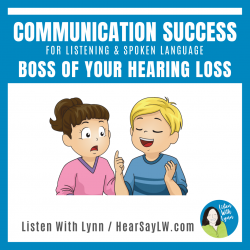
Self-Advocacy Tips for Communication Success
$ 3
Ten self-advocacy tips for communication success for children that are deaf and hard of hearing who use listening and spoken language.
...
How You Hear Depends on the Situation
$ 1
How You Hear Depends on the Situation is an instructional worksheet activity in which the student must 1) identify the level of difficulty of listening challenges, 2) provide an example of when they e
...
xperienced such a situation, 3) come up with examples of what they can do in response to the situation and 4) identify what they could ask their teacher, friends or family to do. A good teaching tool or progress monitoring activity after self-advocacy strategy instruction. From Building Skills for Success in the Fast-Paced Classroom.


Advocacy - Supplement to Steps to Success BUNDLE
$ 1095
This bundle of teacher information, worksheets, and activities include a range of advocacy topics from college preparation, to living indpendently. Students will acquire new vocabulary, use critical
...
thinking skills to solve problems, opportunities for self-discovery and discussion, and above all learn the who, what, when, how, and why of self-advocacy. Though some activities can be modified for upper elementary, most activities are for intermediate to advanced learners. 41 pages. Collected IDs in the BUNDLE: S0XHLU0740, S0XHLU0741, S0XHLU0742, S0XADV0743, S0XSOC0744, S0XSM0745, S0XADV0748.

IEP at a Glance Resource for DHH Students (Deaf Education)
$ 2
It is so important for our students who are deaf/hard-of-hearing to have an understanding of their IEP plans. My students who were the strongest advocates always knew what their accommodations were!Th
...
is is a 2-page resource that you can use to review basic information on a student's IEP. You can review the student's IEP together and then fill out the form. You can also encourage your student to have a copy of this form with them in case they need to reference it or a show a teacher.The form includes spaces for basic IEP and case manager information, hearing loss information, equipment information, placement details, and goals.Have a great start to the school year!

Let's Talk! Communication Breakdown & Repair
$ 395
A wordless book to facilitate teaching and discussion of Communication and Communication Breakdown, including vocabulary: speaker, listener, message, environment, repair. Students identify specific la
...
nguage and strategies for repairing breakdown caused by characteristics of the environment, the speaker and the message.
Lesson 2 - My Legal Rights in High School
$ 0
Unit 2 - Knowledge is My Base. Lessons 1 and 2. Students will learn that the foundation to knowledge is a basic understanding of the law, and they will learn about two important aspects of the law. By
...
Kris English
Preschool Skills for Hearing Aid Independence and Self-Advocacy
$ 195
Skill development is defined for preschool children prior to kindergarten. Chart specifies 7 skills and the roles of the preschool teacher, child and the DHH professional in achieving these goals. The
...
information describes how the Ling sound listening check should be performed in preschool.

 Cookies