 Your browser is out of date. For best experience switch to latest updated Browser.
 Get Chrome
 Get Edge
 Get Firefox
Ability Levels
Categories
Resource Types
Age/Grade Range
CCSS
Anchor Standard
Speaking & Listening
Language
Reading
Self-Advocacy - Describing HL and Accommodations
$ 2
Fun ideas for role-playing activities with students to help them explain and advocate for what they need in order to communicate with peers and teachers.

"The Sky's The Limit"
$ 299
A collection of comic strips revealing troublesome situations for teens with hearing loss. Includes commentary on how each humorous situation might be resolved.
...
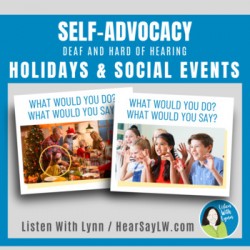

Self-Advocacy Mini Lessons Year Round Holidays and Social Events
$ 7
Ten Self-Advocacy Mini-Lessons with Year-Round Scenarios Featuring Social Events and Settings For Kids That Are Deaf and Hard of Hearing.Each scenario is made up of 3 parts:➼ Part One Real photos illu
...
otos illustrating a challenging listening situation at a celebration, gathering, or holiday event.➼ Part Two Guided questions, talking points, and discussion prompts.➼ Part Three Each scenario has a paired Try This! section with advocacy strategies to guide further learning.★ Digital No-Prep or PlanningEasily used by parents at home, teachers, and therapists both face-to-face and on tele-platforms. When playing on a computer, open and use a PDF reader such as the free Adobe Acrobat Reader DC. It can be opened and played with your favorite PDF reader app on a tablet or on an iPad.◈ ◈ ◈ ◈ ◈ ◈ ◈ ◈ ◈ ◈ ◈ ◈ ◈ ◈ ◈ ◈ ◈ ◈ ◈ ◈ ◈ ◈ ◈ ◈ ◈ ◈ ◈ ◈ ◈ ◈ CUSTOMER TIPS➼ Questions? EMAIL ME before purchasing this resource or anytime later♥ Sign-up HERE for the Listen With Lynn Emails♥ Let’s ConnectInstagramFacebookKeep up your good work. I am blessed to help along the way.Thanks so much!Lynn Wood
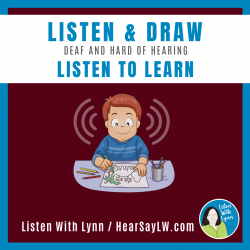
Self-Advocacy Listen & Draw Directions DHH
$ 3
LISTEN TO LEARN is the eighth in the popular Listen & Draw series. These are all auditory imagery activities that target following directions while growing vocabulary, memory and sequencing skills. De
...
etails can be easily simplified or information added to increase the complexity to match the child’s listening and language goals.Children listen to detailed descriptions then follow the directions and draw four different young students all of which are deaf or hard of hearing and use hearing technology. A couple of the kids could be better listeners which is both entertaining and learning opportunities for the kids.Isabella hears with two cochlear implants.Watson hears with two hearing aids.Bryn hears with a Baha® device.Noah hears with a hearing aid in his left ear and a cochlear implant on the right. This LISTEN TO LEARN activity also targets self-advocacy skills. Talking through each scenario will encourage your students to understand the importance of listening to learn and be successful at school.Listening and Spoken Language (LSL) tips are included to encourage auditory learning.

Self-Advocacy - SODAS Problem-Solving Strategy
$ 195
This
article presents the acronym SODAS - identify the Situation, consider the
Options, identify the Disadvantages, identify the Advantages, choose a
Solution. It offers materials and sug
...
gestions for introducing students to,
and implementing, this flexible problem-solving strategy. Includes a
worksheet for students to use for guided practice of this strategy.
Lesson 3 - My Legal Rights - 504 After High School
$ 0
Lesson 3 - My Legal Rights When I Leave High School: Section 504 and College. This lesson describes how Section 504 protects students' rights as they move from high school to college. Students will le
...
arn 6 specific aspects of college education protected by section 504 and IDEA. By Kris English.
Parts of the Ear Game
$ 5
This is a fun digital learning activity for a student to review the 3 parts of the ear. The learner identifies the function of each part, what is in each part and uses a diagram to identify parts of t
...
he ear.There are very few digital learning activities available today. Advocacy practice for students with hearing loss includes learning about hearing. As students begin to learn how they ear, identifying the 3 parts of the ear is a first step. They need lots of practice labeling different parts of the ear and identifying how they help with hearing. Learning Objective:1. The student will be able to identify functions of the 3 parts of the ear. 2. Given a diagram, the student will label the part of the ear.
Self-Advocacy - Specific Requests Get Results
$ 0
This
article discusses the need to self-advocacy in situations of communication
breakdown. There is a specific requests discussion guide and examples of
specific requests.
...

Self-Advocacy - Preparing for Fall
$ 0
Information and ideas to prepare your students for a great start to the year!

Advocacy Timeline
$ 195
This fillable sheet is a great tool to use as practice to create awareness about specific accommodations needed at an event. Students gather information about the event type, location, and activity i
...
n order to determine the best access for them.

 Cookies