 Your browser is out of date. For best experience switch to latest updated Browser.
 Get Chrome
 Get Edge
 Get Firefox
Ability Levels
Categories
Resource Types
Age/Grade Range
CCSS
Anchor Standard
Speaking & Listening
Language
Reading

Pete's a Pizza (HEA 12)
$ 195
Pete's a Pizza - Early Childhood / Preschool teaching materials for the book includes a) a synopsis of the storybook b) a letter to send home to families explaining the storybook unit and activities t
...
hey can do at home c) suggestions for setting up your classroom to revolve around the story (dramatic play area, sensory area, art area, science area, book area, and bulletin board) d) activities separated into two weeks, each week including: a distinctive thematic, e) focus of the Week; Circle Time activities including songs, poems, fingerplays, and story-reading ideas; and six detailed Group Activities with designated target areas, f) snacks related to the story, g) a Pretest and Posttest

Take Charge of Communication Breakdown for Grades 3-5
$ 8
A ten-page comic-style book (in color & grayscale) defines communication and communication breakdown. Examples are shown as interactions between two boys: Luke and Ricardo. A teacher acts as narrator
...
and discusses three tools for repairing communication breakdown: signaling the breakdown, asking for repetition and repeating what was heard. The boys use each tool in responding to a single CBd event. A glossary is provided at the end of the book. Materials also include a graphic organizer, 8 discussion-starter cards, 6 review cards and 5 comprehension questions for assessment. Teacher notes explain how the lesson materials can be used in face-to-face lesson or on a digital platform.

Social - Developing Word Choice for Emotions
$ 2
Gives a word bank of emotions by degree of intensity, emotions activities and instructional strategies to teach verbal expression of emotion.
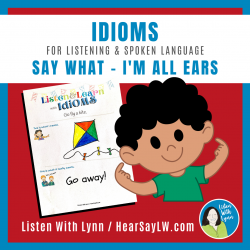
Listen and Learn Idioms Set One I’m All Ears
$ 4
Listen and Learn Idioms SET ONE is part of a growing series of SAY WHAT? - I'M ALL EARS mini-lessons that are well-loved by kids and adults alike.Listen and Learn Idioms TARGET:Listening and spoken la
...
language, figurative language, vocabulary, word relationships, nuances, and higher-level critical thinking.IDEAL FOR: Listening & Spoken Language, Deaf & Hard of Hearing, Speech, ELA, Teletherapy, Distance Learning, Print…WHAT'S INCLUDED:PDFs of 20 idioms in every packet. Use one or all!Listen and Draw MINI-LESSON sheets with A box to draw and illustrate - THIS IS WHAT I HEARD A box for - SAY WHAT? THIS IS WHAT IT REALLY MEANS!A guide and instructions to makes lessons a piece of cakeData and Progress monitoring sheetsAn answer keyA boatload of book titles are included for further and home learningTerms of Use➯ The PDFs can be printed, screen shared in teletherapy or remote learning platforms, used in face-to-face sessions or lessons, and can be sent home for carryover or homework.SAY WHAT? Here's the trick to make idioms stick! Many commercially available resources provide ILLUSTRATIONS of the literal meaning of the idiom. While this may be entertaining RESEARCH indicates that children who:➼ LISTEN to the idiom➼ VISUALIZE the figurative language➼ DRAW what they literally heard followed by teaching the meaning andusing it in context increases long-term learning.Hearing LossChildren with typical hearing, learn idioms through incidental exposure without having to be taught. Whereas, children who are deaf and hard of hearing often require explicit and direct instruction with higher-level language like idioms. Idioms are challenging for children that process information literally and have a concrete or limited vocabulary.

The Little Mouse, the Red Ripe Strawberry, and the Big Hungry Bear (HEA 10)
$ 195
The Little Mouse, the Red Ripe Strawberry, and the Big Hungry Bear - Early Childhood / Preschool teaching materials for the book includes a) a synopsis of the storybook b) a letter to send home to fam
...
ilies explaining the storybook unit and activities they can do at home c) suggestions for setting up your classroom to revolve around the story (dramatic play area, sensory area, art area, science area, book area, and bulletin board) d) activities separated into two weeks, each week including: a distinctive thematic, e) focus of the Week; Circle Time activities including songs, poems, fingerplays, and story-reading ideas; and six detailed Group Activities with designated target areas, f) snacks related to the story, g) a Pretest and Posttest

The Very Hungry Caterpillar (HEA 15)
$ 195
The Very Hungry Caterpillar - Early Childhood / Preschool teaching materials for the book includes a) a synopsis of the storybook b) a letter to send home to families explaining the storybook unit and
...
activities they can do at home c) suggestions for setting up your classroom to revolve around the story (dramatic play area, sensory area, art area, science area, book area, and bulletin board) d) activities separated into two weeks, each week including: a distinctive thematic, e) focus of the Week; Circle Time activities including songs, poems, fingerplays, and story-reading ideas; and six detailed Group Activities with designated target areas, f) snacks related to the story, g) a Pretest and Posttest

Barn Dance (HEA 5)
$ 195
Barn Dance - Early Childhood / Preschool teaching materials for the book includes a) a synopsis of the storybook b) a letter to send home to families explaining the storybook unit and activities they
...
can do at home c) suggestions for setting up your classroom to revolve around the story (dramatic play area, sensory area, art area, science area, book area, and bulletin board) d) activities separated into two weeks, each week including: a distinctive thematic, e) focus of the Week; Circle Time activities including songs, poems, fingerplays, and story-reading ideas; and six detailed Group Activities with designated target areas, f) snacks related to the story, g) a Pretest and Posttest

Language - Adjectives: Tell me about it!
$ 495
Describes how adjectives help us more clearly visualize the person, place or thing being described. Includes activities, book suggestions, and 9 worksheets to develop use of adjectives in speech and w
...
riting. Worksheets include: adjective picture cards for pre-k and K-1; color and describe a chair; using comparative and superlative adjectives; create an adjective bank; using cumulative and coordinate adjectives for advanced readersGives an adjective rubric and sample IEP goals.
Parent Interview Progress Report
$ 0
This checklist is designed to be part of biannual discussions and monitoring between early intervention professionals and family members of infants and toddlers with hearing loss. Family members are a
...
sked to consider the different areas that can affect the rate that communication skills develop and how often their child receives attention to each of these considerations. Areas covered are: Auditory Communication, Visual Communication, and Effective Communication Strategies.

Bear Snores On (HEA 9)
$ 195
Bear Snores On- Early Childhood / Preschool teaching materials for the book includes a) a synopsis of the storybook b) a letter to send home to families explaining the storybook unit and activities th
...
ey can do at home c) suggestions for setting up your classroom to revolve around the story (dramatic play area, sensory area, art area, science area, book area, and bulletin board) d) activities separated into two weeks, each week including: a distinctive thematic, e) focus of the Week; Circle Time activities including songs, poems, fingerplays, and story-reading ideas; and six detailed Group Activities with designated target areas, f) snacks related to the story, g) a Pretest and Posttest

 Cookies