 Your browser is out of date. For best experience switch to latest updated Browser.
 Get Chrome
 Get Edge
 Get Firefox
Ability Levels
Categories
Resource Types
Age/Grade Range
CCSS
Anchor Standard
Speaking & Listening
Language
Reading
SAC-A: Self-Assessment of Communication-Adolescent
$ 0
The purpose of the SAC-A student checklist is to identify problems that students may be experiencing because of their hearing loss and the effect it has on the student's self-concept, interactions, an
...
d hearing device use. To be completed by the student with hearing loss. Fillable version at S0XASM0592.

The Friendly Audiogram
$ 7
Interactive Learning Tool for StudentsSelf-advocacy goalTransition goalsStudent ownership Time Savers for TODsInservice Visuals, Video Links, HandoutsFillable Rubric & AudiogramMatching Rubrics & Sugg
...
ested IEP goals"The Friendly Audiogram" is an interactive set of activities for students and resources for the TOD. School-age students with hearing differences can use these activities to meet IEP goals in self-advocacy. The kid-friendly accommodations and audiogram pages are easy and engaging for younger students to understand and for older students to present at their IEP meetings. There are additional audiology-related vocabulary activities that will benefit them beyond their audiogram. For the Teachers of the Deaf, there are suggested video links for simulating hearing loss & explaining how to use common FM/DM/Sound Field, suggested IEP goals, and rubrics. The audiogram and accommodations page can be printed or emailed to families and/or staff.***For EIECSE families, this starts the family's understanding of what's to come in preschool/kindergarten. They better understand where they are headed and why applying the accommodations in the home environment is important.
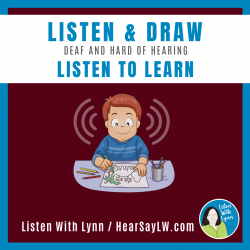
Self-Advocacy Listen & Draw Directions DHH
$ 3
LISTEN TO LEARN is the eighth in the popular Listen & Draw series. These are all auditory imagery activities that target following directions while growing vocabulary, memory and sequencing skills. De
...
etails can be easily simplified or information added to increase the complexity to match the child’s listening and language goals.Children listen to detailed descriptions then follow the directions and draw four different young students all of which are deaf or hard of hearing and use hearing technology. A couple of the kids could be better listeners which is both entertaining and learning opportunities for the kids.Isabella hears with two cochlear implants.Watson hears with two hearing aids.Bryn hears with a Baha® device.Noah hears with a hearing aid in his left ear and a cochlear implant on the right. This LISTEN TO LEARN activity also targets self-advocacy skills. Talking through each scenario will encourage your students to understand the importance of listening to learn and be successful at school.Listening and Spoken Language (LSL) tips are included to encourage auditory learning.
Self-Advocacy for Young DHH Students: Scripts for Fixing Difficult Listening Situations
$ 350
This resource contains 15 possible scenarios that young DHH learners may encounter. For each scenario, they are given 2 choice for scripts which would be the most helpful way to respond the problem. T
...
he provider can help the student pick the most appropriate thing to say to access their needs.
Self-Advocacy Menu of Strategies
$ 250
List of self-advocacy strategies associated with responses on LIFE-R Student Assessment. Recommended activities and self-advocacy skills to use with the classroom teacher, friends, and requesting acco
...
mmodations. Overview to learning self-advocacy for students.
Lesson 4 - My Legal Rights - ADA After High School
$ 0
Lesson 4 - My Legal Rights When I Leave High School: ADA and Work. This lesson provides basic information about the ADA, particularly its protections for persons in work settings and community service
...
s. Learners will compare and contrast the components of IDEA, 504, and ADA. By Kris English.
Self-Advocacy Role Play Real Life Connections
$ 7
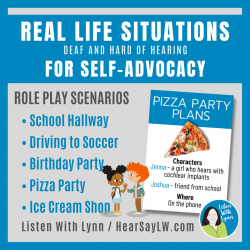
This Self-Advocacy resource is a favorite of students who are deaf and hard of hearing. There are five situations to role-play where players assume the role of kids at school, at home, with peers, and
...
and in their community. They are all derived from situations of actual kids I've seen for therapy.Self-advocacy success requires knowledge, skills, and most importantly practice. These situations provide opportunities for kids to grapple with challenging situations and explore communication repair strategies within a supported environment. Included:★ Five Scenarios - Two Parts Each1. At School In The Noisy Hallway2. Driving To Soccer3. After the Birthday Party4. Pizza Party Plans5. At The Ice Cream Shop★ Self-Advocacy Coping Strategies:➼ Part One illustrates a communication breakdown when the studentuses Escape or negative strategies.➼ Part Two is the scenario again with the new Take Charge orpositive strategies.★ Talking Points➼ Provided to engage and support a discussion.No-Prep or Planning- For face-to-face sessions and in teletherapyDigital ResourceOptional: Print the role-play scenarios for the students★ Boom LearningThis Self Advocacy For Role Play is also available as a Boom Deck in the Listen With Lynn Boom Learning Store. To use Boom Cards, you must be connected to the internet.◈ ◈ ◈ ◈ ◈ ◈ ◈ ◈ ◈ ◈ ◈ ◈ ◈ ◈ ◈ ◈ ◈ ◈ ◈ ◈ ◈ ◈ ◈ ◈ ◈ ◈ ◈ ◈ ◈ ◈ CUSTOMER TIPS:➼ Questions? EMAIL ME before purchasing this resource or anytime later.♥ Sign-up HERE for the Listen With Lynn Emails♥ Let’s Connect:InstagramFacebookKeep up your good work. I am blessed to help along the way.Thanks so much!Lynn Wood

Elephant in the Room (iBook)
$ 6
Skyler has a hearing loss. And he doesn’t feel much like talking today. No wonder—he keeps missing what his parents and siblings have to say, and it’s frustrating. Skyler’s little sister, Maizy, tags
...
y, tags along on his morning routine and, with the help of her special friend, we learn that it takes more than hearing aids to help Skyler feel like talking again.This 35-page full color children’s book by Audiologist Jim Bombicino provides avenues for discussion and building vocabulary by highlighting the difficulties that students may face each day, including mishearing and misunderstanding information, the effect of background noise, and consequential frustration and confusion that can happen when the ease of daily communication is taken for granted by typically hearing persons. In this case, the story follows a young boy as he awakens and prepares for a typical school day.The e-book version includes audio of the text read by actors, while their voices are filtered to imitate how Skyler hears through his hearing aids! Listening situations include a speaker with added background noise, simultaneous speakers, a speaker talking too quickly, and mishearing words—all heard as they come through Skyler’s hearing devices. Perfect for helping teachers, families, and classmates understand what a hearing loss might be like. Finally put typically hearing adults and children in the shoes of the child with hearing loss!Please note: Compatible only with iPad and iOS devices. Free Author’s notes and discussion guide are available for download at Teacher Tools Takeout marketplace.How to Open ePub Files on Your iPad.Before trying to load the ePUB file make sure you have downloaded and installed iBook app from Apple’s app store.Directly on the iPAD or Iphone (recommended)1. Make sure the free iBooks app is on your iPad.2. Follow the link from Safari to reach the ePub document. This means either accessing your email to find the attached file, or going to our website to download the file with an access code.3. Select “Open in iBooks” on the iPad/iPhone4. The eBook will open and be added to your iBooks collection.5. From now on, you can open the ePub document from the iBooks app on your iPad/iPhone.From PC to iPAD1. Make sure the free iBooks app is on your iPad.2. Make sure the free Itunes app is on your PC. Open iTunes.3. Find the ePub file on your computer by accessing email or visiting website where purchased/obtained.4. Drag and drop the ePub file onto your Library in iTunes on your computer.5. Connect your iPad to your computer.6. Check under the “Books” tab in iTunes to be sure this ePub is selected for syncing7. Then sync.8. The ePub document is added to your iBooks collection inside the iBooks app.9. From now on, you can open the ePub document from the iBooks app on your iPad.Directly on PCHow to read Open EPUB or Open PDF e-books on a computer1. Download the free Adobe Digital Editions: https://www.adobe.com/solutions/ebook/digital-editions/download.html2. Open Adobe Digital Editions (ADE) on your Windows or Mac computer.3. Go to File > Add to Library.4. Find the saved EPUB or PDF file on your computer. By default, files are saved to your computer’s “Downloads” folder.5. Double-click an e-book to start reading, or follow these steps to transfer it to an e-reader.

CAVE Checklist - Communication Access in Virtual Education (French) - fillable
$ 0
The CAVE Checklist in French is a self-report checklist is intended to be completed students age 9 and above who are deaf or hard of hearing to identify possible communication access issues that may o
...
ccur during virtual education situations. It is recommended that the CAVE be completed in an interview format with the DHH specialist discussing each situation with the student. Students read 10 questions related to accessing communication in online learning situations and rate them from Always Easy to Always Difficult, or Doesn't Happen. A total score can be obtained. Not every situation will apply to every student. Situations indicating appropriate access will receive scores of 4 or 5. Items scoring 1, 2, 3, need to be addressed for appropriate access needs. The 10 questions are followed by a list in which the student identifies what he or she thinks helps most during online learning.
Steps to Success Worksheets
$ 35
A
companion piece to the Steps to Success Curriculum (ID# 1305), this bundle of
65 fill-in worksheets provided students with practice in key advocacy skills,
reading activities on both a basic and
...
advanced level and real-life language
development. The use of real photos, graphs and visual organizers support
retention of information and hold student’s interest. Goal area worksheets
address the following topics: 1. Understanding the science of hearing 2. Using
technology 3. Developing language processing skills 4. Self knowledge 5. Social
interaction and language 6. Practicing self-management 7.
Understanding rights and access 8. Accommodations and advocacy. Supplemental expansion worksheets for each goal are also available. See ID # 0740 - 0748.

 Cookies