 Your browser is out of date. For best experience switch to latest updated Browser.
 Get Chrome
 Get Edge
 Get Firefox
Ability Levels
Categories
Resource Types
Age/Grade Range
CCSS
Anchor Standard
Speaking & Listening
Language
Reading
Planning Checklist for Self-Advocacy & Instructional Access
$ 195
The Planning Checklist for Self-Advocacy & Instructional Access provides general goals for a student with acceptable school access and then provides very extensive adaptions for the school team to con
...
sider related to communication access, communication interaction goals, and additional supports. This resource also provides extensive resources verifying specific specialized instructional supports.

IEP/504 Checklist: Accommodations and Modifications for Students who are Deaf and Hard of Hearing
$ 0
One-page checklist for school teams to use when considering school accommodations for students with hearing loss. From Educational Audiology Handbook.
Additional Classroom Support
$ 6
The provision of differentiated teaching methods is not sufficient to support a child with hearing loss adequately in a mainstream school. Additional classroom support needs to be provided as well. Al
...
l of the classroom supports mentioned are very important to consider for students with hearing loss. What support and the degree of support needed should be based on assessment information that has been tailored to identify the specific educational performance needs of students with hearing loss.The services or supports provided will most often consist of specialized instruction detailed on the student’s Individualized Education Plan (IEP) and/or accommodations identified to address communication access issues of these students. Pull-out services by special educators, one-on-one with students or in small groups are usually necessary to meet specific needs. Push-in services where educational specialists work in a team-teaching model along with the classroom teacher or provide small group instruction in the classroom can often address some of the students’ language issues, social needs, and academic challenges.Regardless of current common practice, the array of supports described in this module should be considered by the school team, followed by discussions to determine intensity of intervention required for appropriate progress, who will provide these supports and services, and how best to meet the student’s educational performance with the goal of keeping pace with cognitive peers in the classroom.
Listening Breaks & Auditory Fatigue
$ 7
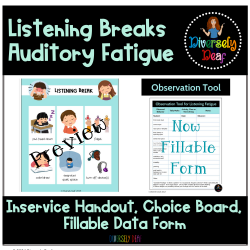
Ways this product can be usedInservice HandoutClassroom PosterStudent Choice BoardDiscussion starter with DHH kidsData collection tool Printable and FILLABLEThe visuals representing listener break cho
...
oices are useful for students with hearing differences who need a listening break but are not self-aware or unable to manage the fatigue before it impacts their education.The observation tool is used by staff to collect data and identify factors similar to the process of an FBA. Is there a pattern? Is it occasional, frequent, or chronic? What precedes the fatigue? Hungry? Good night sleep? If listener fatigue is a possibility discuss your findings with the Teacher of the deaf.
LIFE-R Student Appraisal with Photos for Each Question. Listening Inventory For Education-Revised (fillable)
$ 595
Listening Inventory For Education - Revised 15 questions in the Student Appraisal. Photos of school situations representing each question. Emoji icons representing rating scale choices. Fillable.
Auditory Skills Checklist - fillable
$ 395
The Auditory Skills Checklist has 10 levels of skill development with 4 general skills at each level and early childhood examples of the skill. The checklist includes space to include date each skill
...
was acquired and whether it was E, inconsistnt or acquired. Fillable version
Preschool SIFTER - Screening Instrument For Targeting Educational Risk - Turkish Translation
$ 0
Turkish Translation - The Preschool Screening Instrument For Targeting Educational Risk (SIFTER) was created as a tool to screen the functional performance of students with hearing loss in preschool t
...
hrough kindergarten (ages 3-6). It includes a scoring grid to identify areas of concern.
IEP Checklist
$ 0
This is a checklist for parents and teachers to consider as they develop the IEP. From www.peatc.org.

Individual Education Plans (IEP) and 504 Plans
$ 0
Informational handout for families on the two primary laws that cover a child's rights to a public education: IDEA and 504. Includes a 1-page checklist of accommodations to consider for students with
...
hearing loss.
Professional and Personal Life Balance
$ 295
This information discusses how to create an enriched professional life and a balanced personal life. It includes actions to manage time, stress and record keeping; benefits of continued professional d
...
evelopment; professional codes of ethics and how to deal with ethical dilemmas.

 Cookies