 Your browser is out of date. For best experience switch to latest updated Browser.
 Get Chrome
 Get Edge
 Get Firefox
Ability Levels
Categories
Resource Types
Age/Grade Range
CCSS
Anchor Standard
Speaking & Listening
Language
Reading
The Nature of Inclusive Education
$ 6
Choosing the most appropriate school for a child requires collaboration between the parents and the school. Together, they should decide which will be the best option for the child. This module define
...
s the concept of inclusive education, as well as the barriers which a child with hearing loss could experience. However, these barriers can be overcome through an attitude of determination, with ongoing training and self-enrichment on the part of the teacher and the broader community. Overcoming the barriers is imperative for inclusion to be successful. Inclusive education starts with parents advocating for their children with school management.Inclusion exposes a child with hearing loss to individualized teaching strategies. It requires additional support from family and the school team, which usually includes the classroom teacher and the teacher of the deaf/hard of hearing and may also include the speech-language therapist and other special education support staff in the child’s school.The purpose of inclusive education is to ensure that all children gain access to knowledge and skills that will make them socially and economically independent. The main requirement for inclusion is that the school must be willing to accept the challenge and adapt.
Brochure - Hearing Loss in One Ear - Unilateral Hearing Loss
$ 0
Printable brochure for families of infants and toddlers diagnosed with unilateral hearing loss. Includes prevalence, impact, and things parents can do.
Minnesota Resources for Assessment of Students Who are Deaf and Hard of Hearing
$ 0
Extensive assessment resource developed by DHH professionals in Minnesota. Overview of assessment, formal vs. informal, intellectual, social emotional, language, reading, early childhood, transition,
...
appendices. Revised in 2008.
BUNDLE - 10 files from the Itinerant Teacher's Handbook
$ 2595
This bundle includes 10 files from The Itinerant Teacher's Handbook: 1) Potential Impact of Hearing Loss, 2) Collaborative Relationships, 3) Life Balance, 4) Collaborative Teamwork, 5) Making Inclusio
...
n Work, 6) Promoting Language and Literacy, 7) Helping Parents Communicate, 8) Promoting Social Skills, Friendships, Self-Advocacy, 9) Assessment Issues, 10) Planning Transitions. Save 33% over purchasing all 10 separately. NOTE: Printed book is available for $59. P05TEA0426-435)
PARC: Placement And Readiness Checklists for Students who are Deaf and Hard of Hearing
$ 0
Suite of checklists: 1) General Education Inclusion Readiness Checklist, 2) Interpreted / Transliterated Education Readiness Checklist, 3) Captioning / Transcribing Readiness Checklist, 4) Instruction
...
al Communication Access Checklist, 5) Placement Checklist for Children who are DHH Preschool / Kindergarten, 6) Placement Checklist for Children who are DHH Elementary, 7) Placement Checklist for Children who are DHH Secondary.
COMPASS Test
$ 0
Dave
Syndrey created a functional test of fine auditory discrimination and has
allowed Supporting Success to make it available. COMPASS test recording form,
test interpretation guide, and
...
COMPASS cards for print.
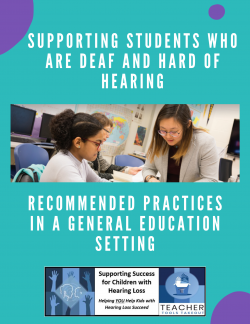
Supporting Students who are Deaf and Hard of Hearing: Recommended Practices in a General Education Setting
$ 0
Tip sheet for related service providers with 5 main tiPS-. From Clerc Center Gallaudet.
Student Listening Challenges – Puzzle Piece
$ 3
Student Listening Challenges – Understanding the Missing Pieces summarizes the results of a Functional Listening Evaluation in a way that helps educators and family members understand listening challe
...
lenges under the different conditions of near, far, in quiet and in noise. Includes an image of a story imposed on puzzle pieces with different parts of the text missing to correlate with decreased speech perception due to hearing loss and listening under different auditory challenges.
Teaching to Our Students Strengths and Needs
$ 195
This article summarizes recent research regarding the language and cognitive differences between students who are DHH and their hearing peers. Identification of these differences can help professional
...
s better understand classroom challenges faced by our students and strategies to support students through these challenges.

SIFTER - Screening Instrument For Targeting Educational Risk - Arabic Translation
$ 0
Arabic Translation - The Screening Instrument For Targeting Educational Risk (SIFTER) was created as a tool to screen the functional performance of students with hearing loss in secondary school (ages
...
12-18). It includes a scoring grid to identify areas of concern.


 Cookies