 Your browser is out of date. For best experience switch to latest updated Browser.
 Get Chrome
 Get Edge
 Get Firefox
Ability Levels
Categories
Resource Types
Age/Grade Range
CCSS
Anchor Standard
Speaking & Listening
Language
Reading

Baby Development and Wearing Hearing Aids - 0-9 Months of Age
$ 195
This information describes infant development in terms of successful hearing aid use and what families should be aware of, and can do to support full-time hearing aid wear. Divided into the age ranges
...
0-6 months and 6-9 months. Provides detail on why to check hearing aids daily and on how to perform a Ling sound listening check starting about 3 months of age.
Research Review - What do DHH Students Think About Captions
$ 0
Discussion
of a 2019 study results gathered the perspectives of DHH students regarding
their satisfaction with various aspects of captioning and areas in which
improvement is needed.
...
; Four key
findings and a summary are included

Summary of Hearing Aid Wear Issues in Early Childhood
$ 1
Summary of issues in getting young children to use hearing aids and what families can do. Chart listing why children may reject their hearing aids and what families can do when the child rejects heari
...
ng aids. Divided into age ranges from K-2; 3-5 years. Also includes information on baby temperament as it can effect hearing aid use and the powerful handout Attitude is Caught, Not Taught which sheds light on how parent behavior helps shape child attitudes toward hearing aid use and hearing loss.
The Nature of Inclusive Education
$ 6
Choosing the most appropriate school for a child requires collaboration between the parents and the school. Together, they should decide which will be the best option for the child. This module define
...
s the concept of inclusive education, as well as the barriers which a child with hearing loss could experience. However, these barriers can be overcome through an attitude of determination, with ongoing training and self-enrichment on the part of the teacher and the broader community. Overcoming the barriers is imperative for inclusion to be successful. Inclusive education starts with parents advocating for their children with school management.Inclusion exposes a child with hearing loss to individualized teaching strategies. It requires additional support from family and the school team, which usually includes the classroom teacher and the teacher of the deaf/hard of hearing and may also include the speech-language therapist and other special education support staff in the child’s school.The purpose of inclusive education is to ensure that all children gain access to knowledge and skills that will make them socially and economically independent. The main requirement for inclusion is that the school must be willing to accept the challenge and adapt.

Self-Advocacy for Young DHH Learners: Scripts for Communication Repair (Part 2)
$ 350
Teaching self-advocacy is SO IMPORTANT for our young learners who are deaf/hard-of-hearing. Over the years, I have found that even though we can teach the skills, we must also focus on teaching the la
...
nguage that is needed to complete the skills.This product contains 15 NEW difficult listening scenarios/communication repair scenarios and possible responses geared toward younger students. Each page contains a simple scenario, and then provides two possible responses for the student to choose from. Some of the responses also offer you the opportunity to use scaffolding, depending on the needs and abilities of your students.These scenarios also work well for students who have lower language abilities!Your students will have fun role-playing these scenarios with you while learning appropriate and effective ways to seek out assistance that they may need in an educational setting.

Listening Hierarchy Speech Discrimination Tool
$ 0
The Listening Hierarchy Speech Discrimination Tool, adapted from David Sindrey, is a step-by-step guide for tracking a child’s auditory skill development. It helps educators and therapists show parent
...
nts measurable progress in listening and speech discrimination, from simple sound contrasts to more advanced distinctions. This tool makes it easy to set goals, document growth, and celebrate communication success.

Student Friendly Adapted SEAM
$ 7
The ADAPTED SEAM uses student-friendly language that activates self-reflective skills, encourages student ownership, and provides an interactive/conversation starter when done with the student. Some s
...
tudents experience an "ah-ha moment" about their responsibility the first time they complete the chart.
Ways To Use This:Discussion tool while completing the data form with your student. Self-reflection tool for older students while providing data for you.Assessment tool for determining self-advocacy present levels. (sample write-up included)Baseline data for your measurable IEP goal. (sample goal included)Students To Use This With?A student who is missing many of these skills at their levelsA student who is NEW to hearing devices regardless of age. An older student needing frequent reminders of these skills can benefit from revisiting the form periodically to track their progress.Why Use this?Editable PDF or Printable (2 versions)Timely benchmarks for progress reportingEasily Attach/Upload to IEP SystemsSample Assessment/Present Level Write-Up provided Sample IEP Goal & Completed Student Example providedWhat's Included in this Adapted SEAM Product?Overview of All Adapted Levels At a Glance (1 page) Directions and Ways To UseEditable PDFs - compact, single-page view. (7 forms/levels: Pre-K, K, 1st-2nd, 3rd, 4th, 5th, MS/HS)Printable Forms - expanded onto 2 sides for reading and writing ease. (7 forms/levels: Pre-K, K, 1st-2nd, 3rd, 4th, 5th, MS/HS)Student Data Example Sample Assessment/Present Levels Write-UpSample IEP goalSample - Real Student Form Completed over an IEP year.
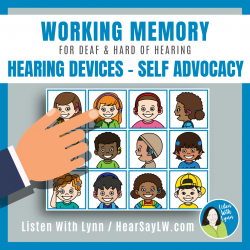
Hearing Devices - Self Advocacy Working Memory
$ 2
If you have students who are deaf and hard of hearing that need help with auditory working memory, executive functioning, and following directions, this Listening Finger Walk is a must-have! It builds
...
lds vocabulary about types of hearing loss and hearing devices. It boosts confidence and helps children feel good about their own hearing technology. It's fun for the kids and a simple no-prep resource for you. Just open the PDF on your screen or print it and go!The colorful playing board features 16 children wearing hearing devices like hearing aids, cochlear implants, and bone-anchored hearing systems. You can target vocabulary like unilateral, bilateral, behind-the-ear, in-the-ear, earmolds, processor, headpiece, magnet, coil, microphone, and more.This Listening Finger Walk:➼ helps build listening skills and working memory by allowing kids to work with auditory information without losing track of what they're doing.➼ targets vocabulary, descriptive skills, spoken language, and communication skills.➼ has three rounds that each increase in auditory complexity.Includes:✧ A Hearing technology or devices theme for therapy sessions or school lessons✧ Listening and Spoken Language Tips✧ Print Version: Easy print and go!✧ Digital Version No Prep Ready to screen sharePlease Note: This activity and the Positive Self-Concept Auditory Learning Games contain similar images of the same children. The resources both target self-advocacy but have different auditory and language-based goals. You will want both resources you will want in your Summer Toolbox.◈ ◈ ◈ ◈ ◈ ◈ ◈ ◈ ◈ ◈ ◈ ◈ ◈ ◈ ◈ ◈ ◈ ◈ ◈ ◈ ◈ ◈ ◈ ◈ ◈ ◈ ◈ ◈ ◈ ◈ CUSTOMER TIPS:➼ Questions? EMAIL ME before purchasing this resource or anytime later♥ ♥ ♥ Sign-up HERE for the Listen With Lynn Emails♥ Let’s Connect:InstagramFacebookKeep up your excellent work. I am blessed to help along the way.Thanks so much!Lynn Wood

Self-Advocacy Scenario Bundle
$ 675
This product contains both of the "Ideal" vs. "Difficult" Listening Scenarios and "Ideal" vs. "Difficult" Listening Scenarios Part 2.This bundle features 30 scenarios that you can use to support your
...
students with their self-advocacy skills. Use these scenarios to discuss problems/solutions that your students may face in a variety of situations.

FIllable Rubric - Cleaning Hearing Aids
$ 1
Why Use This?2025 - It's updated to include hearing aids with domesIEP goal sample includedIEP goal progress monitoring is done quickly!Students and parents can see progress visually on the rubricQuic
...
kly identify what needs more practiceUse this with two social stories related to cleaning your hearing aidsSocial Story - When Your Nose Runs: ENTs, Earmolds, and Earwax.Step-by-step presentation How to Clean Your Hearing Aids with Real Student Photos

 Cookies