 Your browser is out of date. For best experience switch to latest updated Browser.
 Get Chrome
 Get Edge
 Get Firefox
Ability Levels
Categories
Resource Types
Age/Grade Range
CCSS
Anchor Standard
Speaking & Listening
Language
Reading
Article: Social-Emotional Development in Children with Hearing Loss
$ 0
Thesis provides a comprehensive review of social emotional development and children with hearing loss. 2014
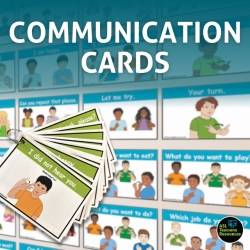
Sign Language Basic Sentences
$ 399
Imagine every student, regardless of their ability to speak, can communicate confidently with everyone around them – from the cafeteria workers who serve them lunch to the teachers who educate them an
...
and the bus drivers who safely take them home. Picture a set of Sign Language Basic sentence cards that unlock the power of language, making it accessible to non-verbal students and ASL users alike. These visual communication cards are not just a tool; they are a bridge that connects children’s wants, needs, and opinions with the world around them.The Basic Sentences communication cards are a game-changer for non-verbal students, allowing them to express themselves effectively and confidently in English and American Sign Language (ASL). Each card features an English sentence and its corresponding ASL sentence, complete with illustrated signs for visual cueing. (Metal ring not included.)The power of communication lies within 54 visual communication cards encompassing children’s fundamental needs, wants, and opinions. For non-verbal students and ASL users, these cards are a lifeline to the world, allowing them to interact meaningfully with peers and adults alike. From simple introductions like “My name is __” to inquire about others’ names, “What is your name?”, these cards facilitate connections and foster a sense of belonging for every student.One of the key benefits of these visual communication cards is their inclusivity. By presenting each sentence in both English and ASL versions, they effectively build a bridge between the two languages, promoting bilingualism and empowering students to express themselves in complete sentences. From stating their emotions, such as “I am excited,” “I am sad,” or “I am happy,” to expressing their needs, like “I am hungry” or “I need help,” the students can now communicate with confidence and clarity.The effectiveness of these communication cards lies not just in the words they convey but in the additional guidance they offer. The ASL sentence cards come with hints on utilizing facial expressions to add ASL grammar, enriching the communication experience and making it more nuanced and expressive. These cards offer phrases for seeking clarification and cooperation, such as “Can you repeat that, please?” or “Can I have a break, please?” enabling students to engage in conversations and navigate various social situations actively.The impact of these cards goes beyond the school’s walls. With newfound communication skills, non-verbal students can confidently communicate with cafeteria workers about their food preferences, thank their teachers for their guidance, and quickly request assistance from bus drivers. These cards foster a more inclusive and understanding school environment as their peers learn alongside them, embracing the richness of ASL and promoting empathy and acceptance.In a world where effective communication is paramount, these Sign Language Basic Sentences cards break down barriers and enable every student to participate fully. With the power of language now at their fingertips, non-verbal students can express themselves, advocate for their needs, and connect with others in a once elusive way. As the school community unites through language, the benefits extend beyond the classroom, creating a more compassionate and inclusive society.
Auditory Language & Learning Guide (ALLG)
$ 10
The Auditory Language & Learning Guide is an EXCELLENT informal evaluation tool for listening and language that can be used with students of any age and language ability. The 2 page checklist format e
...
asily allows the teacher to develop IEP goals based on identified student weaknesses in the 4 areas of audition/listening, receptive language, expressive language, and social communication. Skills can be rated as 'targeted', 'emerging', 'mastered' or 'previously assessed' and checked off by date achieved. This assessment tool can be used from year to year allowing instructors and parents to see growth in a students language and learning.
School Communication Styles - Does this Sound Like You?
$ 175
Presents 3 communication styles: aggressive, passive, and assertive. Provides a means to discuss why advocacy is important in the context of appropriate interaction and peer expectations.
Asking Questions
$ 195
These activities focus on encouraging students to be curious; asking questions to get more information rather than worry about syntactical correctness. Worksheets include: Make up a story using who,
...
what, why, where, and how picture cards; asking questions board game; asking questions in an interview and writing summary of responses; asking why questions - and seeking answers - about the world around us
Making and Staying in Conversations
$ 195
Techniques for keeping all students connected in the diverse classroom. Activities include: picture task cards for young students to describe; situation task cards for older students to practice resp
...
onses; practice clear communications by describing designs for others to draw; communication repair task cards
SIFTER - Secondary Screening Instrument for Targeting Educational Risk
$ 0
The Screening Instrument For Targeting Educational Risk (SIFTER) was created as a tool to screen the functional performance of students with hearing loss in secondary school. It includes a scoring gri
...
d to identify areas of concern. User's manual is at S0XASM0142. Part of the fillable SIFTER Bundle #1289.
SIFTER - Elementary Screening Instrument For Targeting Educational Risk – FILLABLE
$ 10
The
Screening Instrument For Targeting Educational Risk (SIFTER) was created as a
tool tosscreen the functional performance of students with hearing loss in
secondary school (ages 12-18).
...
It includes a scoring grid to identify areas
of concern. FILLABLE version. User's manual is at
S0XASM0142. Part of the fillable SIFTER Bundle
#1289.
SEPTEMBER LISTENING VOCABULARY COMPREHENSION
$ 5
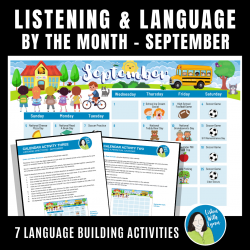
The SEPTEMBER Listening and Language By The Month resource includes seven activities that can be used ALL MONTH for auditory memory and comprehension, seasonal vocabulary, developing grammar, and buil
...
Social Skills & Empathy
$ 225
Feeling empathy for another person is the ability to share or understand his or her feelings. This article discusses how children learn empathy and provides instructional strategies and activities for
...
teaching students to respond with appropriate empathy.

 Cookies