 Your browser is out of date. For best experience switch to latest updated Browser.
 Get Chrome
 Get Edge
 Get Firefox
Ability Levels
Categories
Resource Types
Age/Grade Range
CCSS
Anchor Standard
Speaking & Listening
Language
Reading
Listening Challenge: Understanding the Message & Making polite Requests
$ 195
Students discuss situations that create listening challenges, discuss strategies and polite requests that can address the problem. An all-purpose game board, worksheets and teacher script creating com
...
munication breakdown are provided to facilitate practice.
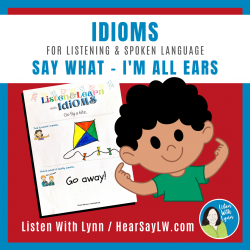
Listen and Learn Idioms Set One I’m All Ears
$ 4
Listen and Learn Idioms SET ONE is part of a growing series of SAY WHAT? - I'M ALL EARS mini-lessons that are well-loved by kids and adults alike.Listen and Learn Idioms TARGET:Listening and spoken la
...
language, figurative language, vocabulary, word relationships, nuances, and higher-level critical thinking.IDEAL FOR: Listening & Spoken Language, Deaf & Hard of Hearing, Speech, ELA, Teletherapy, Distance Learning, Print…WHAT'S INCLUDED:PDFs of 20 idioms in every packet. Use one or all!Listen and Draw MINI-LESSON sheets with A box to draw and illustrate - THIS IS WHAT I HEARD A box for - SAY WHAT? THIS IS WHAT IT REALLY MEANS!A guide and instructions to makes lessons a piece of cakeData and Progress monitoring sheetsAn answer keyA boatload of book titles are included for further and home learningTerms of Use➯ The PDFs can be printed, screen shared in teletherapy or remote learning platforms, used in face-to-face sessions or lessons, and can be sent home for carryover or homework.SAY WHAT? Here's the trick to make idioms stick! Many commercially available resources provide ILLUSTRATIONS of the literal meaning of the idiom. While this may be entertaining RESEARCH indicates that children who:➼ LISTEN to the idiom➼ VISUALIZE the figurative language➼ DRAW what they literally heard followed by teaching the meaning andusing it in context increases long-term learning.Hearing LossChildren with typical hearing, learn idioms through incidental exposure without having to be taught. Whereas, children who are deaf and hard of hearing often require explicit and direct instruction with higher-level language like idioms. Idioms are challenging for children that process information literally and have a concrete or limited vocabulary.
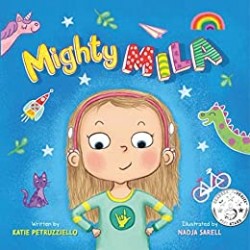
Mighty Mila Activity Pack
$ 0
The Mighty Mila Activity Pack contains 66 pages of 34
fun, educational activities to use by parents and educators in conjunction with
reading Mighty Mila Children's Picture Book by Katie
Petruzziel
...
lo. These activities were created by the author, Katie
Petruzziello (mom to deaf daughter, Mila) and her daughter's Teacher of the
Deaf and Hard of Hearing, Ashley Machovec, in an effort to provide parents and educators
with worksheets that will enhance their child/student's listening skills and
language development in a fun, enjoyable way. It is their goal to
help support parents and educators of DHH children, and as part of that
commitment, the Mighty Mila Activity Pack is currently being
offered for free digital download. The Mighty Mila Activity Pack focuses on the
following:· Story
Sequencing· Comprehension· Emotion
Identification· Descriptive
Language· Story
Recall and Expansion· Listening
for Clues· Listening
Skills/Directions· Positional
Terms· Sound
Identification· Syllables· Games
& Brain Breaks· and
much more!Mighty Mila children's picture book can be
purchased at https://successforkidswithhearingloss.com/product/mighty-mila/Author background: Katie Petruzziello is the author of Mighty Mila, and the
mom of three wonderful (and very feisty!) children, including a strong spunky
daughter who is deaf and uses cochlear implants to hear.When her daughter started questioning why most children's
picture books don't include any deaf/hard of hearing characters like her, Katie
knew she needed to write one. Katie's goal is to increase deaf representation
in children's literature and promote further awareness, inclusion, and
celebration of differences.
Katie is
excited to give the world a fun story
where all kids can fall in love with an imaginative, fierce little girl, who
just happens to be deaf. Mighty
Mila is a labor of love that she hopes will be a cherished book
in many homes. For more information about Katie, Mila and their mission, please
come visit them at www.mightymila.com
or @mightymilastories on Instagram.
Listening Skills - Sounds as Symbols - Onomatopoeia
$ 195
These instructional strategies and activities address sound words or onomatopoeia. Words are used in literature to more precisely describe sounds such as human voices, animal noises, and environmental
...
sounds. Consider the differences in a growl and a hiss; a giggle and a belch; a splash and a spray; a clang and a thud. You will find strategies for teaching such words and a sound bingo game that can be used with beginning and more advanced listeners.
Become a Listening Detective
$ 295
Listening
comprehension has an influence on reading comprehension across development.
This article focuses on auditory comprehension, making inferences when one
reads and when one hears,
...
and becoming a 'listening detective' to make
inferences from what is heard. Two activities, each with 4 parts of listen
and respond activities, mostly on fillable worksheets.
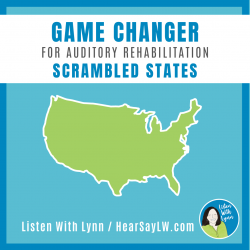
Auditory Rehab - Auditory Training SCRAMBLED STATES Game
$ 6
Play the SCRAMBLED STATES OF AMERICA game with an auditory spin using this Auditory Rehab Game Changer™. This activity is designed for individuals that are deaf and hard of hearing and for use in coch
...
se in cochlear implant rehabilitation for older children, teens, and adults.IDEAL FOR: Deaf & Hard of Hearing, Listening & Spoken Language, Auditory Training, Auditory Rehabilitation, Speech...The SCRAMBLED STATES OF AMERICA Game Changer✤ is played with special directions and rules✤ challenges beginner and intermediate listeners✤ works in closed and bridge listening sets✤ practices identifying words in sets and within connected speech✤ focuses on taking turns, talking while advocating for hearing needs✤ encourages gameplay and practice at home with family and friends✤ practice can lead to communication success✤ is motivating and funGameChangers™➼ result in natural listening practice much different than contrived lists or online or programs.➼ allow for real-time modifications based on the player's auditory skills➼ fosters self-advocacy skills➼ improves communication confidence and successINCLUDES:a pre-game companion that prepares the Listener to play the gamefeatures practice exercises and activities.offers clear directions for therapists, teachers, a listening coach, family members, and friendsincludes listening tips and strategiesfollows an auditory hierarchyNOTE: The amount of practice necessary will vary before a listener is ready to play the game and is dependent upon the listener’s listening skills
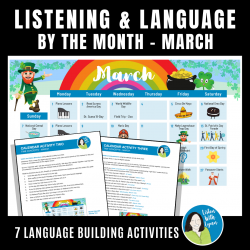
MARCH LISTENING VOCABULARY COMPREHENSION
$ 5
The March Listening and Language By The Month resource includes six activities that can be used for auditory memory and comprehension, seasonal vocabulary, developing grammar, and building conversatio
...
ersational skills. Work smarter, not harder by strategically including ongoing calendar activities all year long while growing listening, building language, literacy, and academic skills. Time concepts are taught, learned, and understood with repetition and practiced over time. The calendar lessons included are based on years of working with children who are deaf and hard of hearing and guiding their families. Includes six activities with four March calendarsCreate an experience-based calendarListen and follow directionsAuditory comprehensionAuditory Inferencing using Claire’s calendarCalendar Conversations Barrier GameAuditory comprehension and integration - Fun Facts About March.Includes✢ A guide for growing vocabulary and time concepts and instructions for using these activities✢ Listening and Spoken Language Tips✢ Engaging activity calendars with rich vocabulary and colorful images Teletherapy, Distance Learning & Face to Face✧ Print version✧ Interactive PDF - No Print version can be opened and played with your favorite PDF reader app on a tablet. When playing on a computer, open and use a PDF reader such as Adobe Acrobat Reader DC which is free.PLEASE NOTE: The activity calendar content and graphics are designed to correspond with each month but not for a specific calendar year. In my therapy sessions, we talk about the featured child - for March is it Claire and her calendar and activities. The calendars do not include a year to keep the product evergreen and usable year after year. ◈ ◈ ◈ ◈ ◈ ◈ ◈ ◈ ◈ ◈ ◈ ◈ ◈ ◈ ◈ ◈ ◈ ◈ ◈ ◈ ◈ ◈ ◈ ◈ ◈ ◈ ◈ ◈ ◈ ◈ CUSTOMER TIPS:➼ Questions? Email me before purchasing this resource or anytime later.♥ Sign-up HERE for the Listen With Lynn Newsletter♥ Let's connect on Facebook and Instagram♥ For more ideas visit my blog: HearSayLW.com
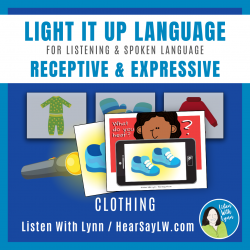
CLOTHING Auditory Processing Receptive & Expressive Language
$ 5
You'll love the CLOTHING version of Light It Up Language! Kids listen to clues presented through hearing alone to identify 16 hidden CLOTHING vocabulary pictures. Each of the pictures has four clues t
...
ues that are increasingly more specific.The magic happens by lighting up the “What Do You Hear?” cards. Hidden pictures are held up to a flashlight and the CLOTHING images amazingly appear. How fun! Once the hidden picture is revealed the child recalls and uses the clues to describe the CLOTHING. Thereby stretching their auditory memory, descriptive language, and expressive language skills.TARGETS: RECEPTIVE: This game builds critical thinking and reasoning skills by categorizing, making inferences, and drawing conclusions. EXPRESSIVE: The child recalls and uses clues to describe the hidden object. INCLUDES:✧ Listening & language guide with instructions✧ Target or goal suggestions✧ 8 What Do You Hear? cards (printed twice)✧ 16 Hidden CLOTHING Picture Vocabulary Cards✧ 64 Prompt Clues - 16 objects with four details each that get increasingly more specific✧ A Script with scaffolding strategies✧ Listening and Spoken Language Tips ➼ EASY one-time quick game prep and you're all set to use year after year. ➼ You’ll need a FLASHLIGHT, a lamp, or a sunny window.◈ ◈ ◈ ◈ ◈ ◈ ◈ ◈ ◈ ◈ ◈ ◈ ◈ ◈ ◈ ◈ ◈ ◈ ◈ ◈ ◈ CUSTOMER TIPS:➼ Questions? Please email me before purchasing this resource or anytime later.♥ Sign-up HERE for the Listen With Lynn emails♥ For more ideas visit my blog: HearSayLW.comSTAY CONNECTED:✧ Sign-up here for the Listen With Lynn emails✧ Follow on Facebook - Lynn A. Wood - LSL Auditory Verbal Therapist and Rehab Audiologist✧ Follow on Instagram @auditoryverbal_listenwithlynn❤ Keep up your excellent work. I am blessed to help along the way. Thanks so much!Lynn Wood

Beyond the Sky’s Limit -PPT
$ 3
NOTE: Powerpoint Presentation for viewing on PCA collection of comic strips revealing troublesome situations for teens with hearing loss. Includes commentary on how each humorous situation might be re
...
resolved.20 more situations and scenarios that mix humor with compassion in negotiating social communication.More antics and advocacy for teens and tweens with hearing loss.
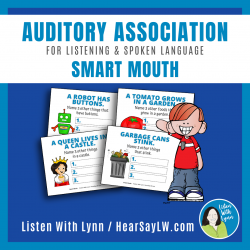
Auditory Association Smart Mouth
$ 5
Smart Mouth is an easy grab-and-go fast-paced LISTENING AND SPOKEN LANGUAGE activity. It fosters quick thinking and allows kids to “blurt” out associated or related words. Then an opportunity for the
...
or the child to use these words expressively is offered which can stretch auditory memory and descriptive skills. Smart Mouth includes answers and data collection and progress monitoring sheets. YOU CAN TARGET: Listening, Auditory associations, auditory processing, critical thinking, and vocabulary. Language can explode while focusing on naming skills, categories, descriptive and expressive language, and communication skills. IDEAL FOR: Listening & Spoken Language, Deaf & Hard of Hearing, Auditory Processing Disorder, Speech and Language Therapy, School Lessons, Auditory Verbal Sessions, PreK-K and Primary Teachers, SPED Teachers, ELL Teachers, ESL/EFL Teachers, Homeschoolers, Teletherapists SMART MOUTH CARDS CAN:accompany motivating companion games by answering a card before each turncan be played for an allotted time using a sand timer or timer appbe played as an active listening activity be an effective brain break when transitioning between activitiesare fun as a reward during the last few minutes of a lesson or session INCLUDES:✧ A guide with instructions ✧ 40 Smart Mouth game cards➼ A set of DIGITAL game cards➼ A set of PRINTABLE game cards✧ Answers for each game card ✧ Progress monitoring or data collection sheets✧ Listening and Spoken Language Tips FACE TO FACE - TELETHERAPY - HOME:✢ DIGITAL - can be opened and played with your favorite PDF reader app on a tablet. When playing on a computer, open and use a PDF reader such as Adobe Acrobat Reader DC which is free. ✢ PRINT - One-time easy prep. Print and cut out the 30 valentines, print the 4 mailboxes, print and cut out the 30 direction cards.

 Cookies