 Your browser is out of date. For best experience switch to latest updated Browser.
 Get Chrome
 Get Edge
 Get Firefox
Ability Levels
Categories
Resource Types
Age/Grade Range
CCSS
Anchor Standard
Speaking & Listening
Language
Reading
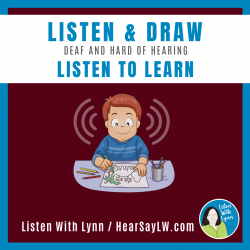
Self-Advocacy Listen & Draw Directions DHH
$ 3
LISTEN TO LEARN is the eighth in the popular Listen & Draw series. These are all auditory imagery activities that target following directions while growing vocabulary, memory and sequencing skills. De
...
etails can be easily simplified or information added to increase the complexity to match the child’s listening and language goals.Children listen to detailed descriptions then follow the directions and draw four different young students all of which are deaf or hard of hearing and use hearing technology. A couple of the kids could be better listeners which is both entertaining and learning opportunities for the kids.Isabella hears with two cochlear implants.Watson hears with two hearing aids.Bryn hears with a Baha® device.Noah hears with a hearing aid in his left ear and a cochlear implant on the right. This LISTEN TO LEARN activity also targets self-advocacy skills. Talking through each scenario will encourage your students to understand the importance of listening to learn and be successful at school.Listening and Spoken Language (LSL) tips are included to encourage auditory learning.
My Child Has Permanent Hearing Loss: Now What?
$ 0
Once a child is diagnosed with hearing loss family members have many questions. This resource provides information addressing how overwhelming the diagnosis can be and families may have many feelings
...
about the testing process and the diagnosis. It describes where you can find help and support and why it is important to start services shortly after the hearing loss is diagnosed.
The Secondary School Survey and Discussion
$ 295
This survey is appropriate for tweens and teens, especially those who are B to resist using hearing aids. It asks questions about how students feel about their hearing loss, hearing devices, and commu
...
nication with hearing loss. Once the student completes the survey their responses can be compared with a large group of students with hearing loss. Provides discussion questions.

Encouraging Positive Self-Concept in Children
$ 0
Informational handout describes the importance of self-concept and suggests ways to assess a student's level of self-concept. It also provides 4 strategies to improve a student's self-confidence.
Self-Advocacy - Who knows me Best? What I know about Myself
$ 195
This lesson plan includes objectives for helping students determine what they know about themselves. Students will be able to find and use descriptive words in writing about themselves and others.
Speaking Up - Being Scared or Prepared?
$ 195
Speaking Up and Being Scared, or Being Prepared? Is a packet of 4 instructional worksheets and a pretest/post-test. The student will explore why many people are afraid of public speaking and specific
...
strategies to feel more confident. The activities pose different situations in which they get in touch with their feeling about the situations and apply the different strategies that would decrease negative feelings and increase self-confidence. Includes a page describing communication strategies that are not successful with a spot for student reflection.
Ten steps you can take to help a child develop a positive self-concept
$ 0
This informational handout provides ten stePS- you can take to help a child develop a positive self-concept. For families.
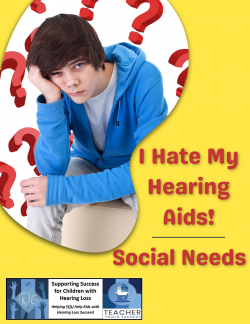
Social Needs & "I hate my hearing aids!"
$ 0
Informational handout reviewing the challenges hearing loss poses to a child's peer acceptance. Peer acceptance also impacts resistance to wearing hearing aids. Responding to hearing aid wear issues i
...
s addressed and some suggestions for intervention.
SOAC-A: Significant Other Assessment of Communication - Adolescent - fillable
$ 195
SOAC-A: Significant Other Assessment of Communication - Adolescent is to be completed by friends/peers of teens with hearing loss as a means to help the student who is DHH to explore their feelings ab
...
out being a communicator with hearing loss. Best when used with the SAC-A - Self-Assesment of Communication to allow comparison to take place to further inform the student with hearing loss about the degree to which hearing peers consider their hearing loss. Fillable version.
What we Know about Why Children Reject Amplification Devices
$ 1
This information reviews research findings that provide insight on which students are more likely to refuse to wear their hearing amplification and reasons why.

 Cookies