 Your browser is out of date. For best experience switch to latest updated Browser.
 Get Chrome
 Get Edge
 Get Firefox
Ability Levels
Categories
Resource Types
Age/Grade Range
CCSS
Anchor Standard
Speaking & Listening
Language
Reading
Bluffing - Guidance for Student Discussion
$ 175
This information provides teachers and families ideas for how to discuss bluffing with children who are deaf or hard of hearing. Children often resort to bluffing, or pretending that they understood,
...
when they lack strategies for how to repair a communication breakdown. Guides discussion, not a worksheet. From Building Skills for Success in the Fast-Paced Classroom.
How You Hear Depends on the Situation
$ 1
How You Hear Depends on the Situation is an instructional worksheet activity in which the student must 1) identify the level of difficulty of listening challenges, 2) provide an example of when they e
...
xperienced such a situation, 3) come up with examples of what they can do in response to the situation and 4) identify what they could ask their teacher, friends or family to do. A good teaching tool or progress monitoring activity after self-advocacy strategy instruction. From Building Skills for Success in the Fast-Paced Classroom.
Informal Inventory or Independence and Self-Advocacy Skills for Deaf/Hard of Hearing Students
$ 0
Teacher Checklist or DHH Specialist rating of independence as a student, self-advocacy, peer interaction, community, use of an interpreter. Scoring identifies level of advocacy and independence. Appro
...
priate for Deaf students and hard of hearing.
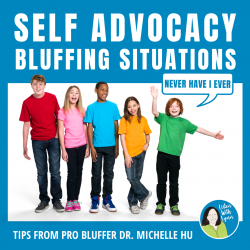
Self-Advocacy Bluffing Situations - Never Have I Ever Activity
$ 7
18 Mini-Lessons target BLUFFING and foster self-advocacy and personal responsibility for kids that are deaf and hard of hearing. This resource is based on the NEVER HAVE I EVER game which is fun and m
...
and motivating for elementary and middle school-aged kids.Bluffing is pretending to hear or acting in a way that shows you understand what is being said when you are not following the conversation. Bluffing, faking, and pretending are common habits of most people with hearing loss.INCLUDED:Tips from Pro-Bluffer, Dr. Michelle Hu, a pediatric audiologist and bilateral cochlear implant recipient. Michelle knows what it is like to bluff and shares words of wisdom based on her life experiences. Follow Michelle on Instagram as she shares her hearing loss journey.18 Never Have I Ever Mini-Lessons✧ Real photos that illustrate the social situations and scenarios✧ Each situation pictures a student who says: (example) "Never Have I Ever pretended that I didn’t want to join in the game.”✧ The kids' self-talk or comments. (example) "It’s easier to not play rather than mishear and mess up."✧ Talking points with guided questions/discussion prompts.Children grapple with BLUFFING in challenging situations. Discussing possible plans of action, and exploring positive coping and communication repair strategies within a supported environment is important. Self-advocacy success requires knowledge, skills, and importantly ample practice opportunities.➼ DIGITAL - NO PRINT can be opened and played with your favorite PDF reader app on a tablet. When playing on a computer, open and use a PDF reader such as Adobe Acrobat Reader DC which is free. ➼ PRINT - Print out the 18 situations and a copy of the Discussion prompts and questions.◈ ◈ ◈ ◈ ◈ ◈ ◈ ◈ ◈ ◈ ◈ ◈ ◈ ◈ ◈ ◈ ◈ ◈ ◈ ◈ ◈ ◈ ◈ ◈ ◈ ◈ ◈ ◈ ◈ ◈ CUSTOMER TIPS➼ Questions? EMAIL ME before purchasing this resource or anytime later.♥ Sign-up HERE for the Listen With Lynn Emails♥ Let’s ConnectInstagramFacebookKeep up your good work. I am blessed to help along the way.Thanks so much!Lynn Wood
Lesson 6 - Setting Goals and Identifying Needs
$ 0
Unit 3 - Personal and Interpersonal Skills for the Self-Advocate. Lesson 6. Students will develop some strategies to help them clarify their goals and identify their needs after high school. By Kris E
...
nglish.
Advocacy in Action Curriculum Upper Elementary
$ 13
Complete curriculum guidance and scenarios for instruction in amplification (including hearing aids, cochlear implants, and FM systems), hearing loss basics including audiograms and ear anatomy, liste
...
ning environments, and social awareness situations.
SAC-A: Self-Assessment of Communication-Adolescent
$ 0
The purpose of the SAC-A student checklist is to identify problems that students may be experiencing because of their hearing loss and the effect it has on the student's self-concept, interactions, an
...
d hearing device use. To be completed by the student with hearing loss. Fillable version at S0XASM0592.


Super Kena - A Girl Made Fierce with Hearing Aids
$ 995
“Super Kena – A Girl Made Fierce with Hearing Aids” is meant to empower children with hearing aids like Kena but also other “differently-abled” children who get teased and only want to fit in.The book
...
fit in.The book touches on children with glasses, with diabetes, who stutter, who have food allergies, with asthma, and who are in wheelchairs. Together they use their unique super powers to make a difference in the world by spreading understanding and acceptance . . . one classroom at a timeNOTE!!How to read Open EPUB or Open PDF e-books on a computer:Download the free Adobe Digital Editions: https://www.adobe.com/solutions/ebook/digital-editions/download.htmlOpen Adobe Digital Editions (ADE) on your Windows or Mac computer.Go to File > Add to Library.Find the saved EPUB or PDF file on your computer. By default, files are saved to your computer's "Downloads" folder.Double-click an e-book to start reading, or follow these steps to transfer it to an e-reader.Under top menu ‘Reading,’ select Double Page View

Advocacy - Supplement to Steps to Success BUNDLE
$ 1095
This bundle of teacher information, worksheets, and activities include a range of advocacy topics from college preparation, to living indpendently. Students will acquire new vocabulary, use critical
...
thinking skills to solve problems, opportunities for self-discovery and discussion, and above all learn the who, what, when, how, and why of self-advocacy. Though some activities can be modified for upper elementary, most activities are for intermediate to advanced learners. 41 pages. Collected IDs in the BUNDLE: S0XHLU0740, S0XHLU0741, S0XHLU0742, S0XADV0743, S0XSOC0744, S0XSM0745, S0XADV0748.
Self-Advocacy - Describing HL and Accommodations
$ 2
Fun ideas for role-playing activities with students to help them explain and advocate for what they need in order to communicate with peers and teachers.

 Cookies