 Your browser is out of date. For best experience switch to latest updated Browser.
 Get Chrome
 Get Edge
 Get Firefox
Ability Levels
Categories
Resource Types
Age/Grade Range
CCSS
Anchor Standard
Speaking & Listening
Language
Reading

"The Sky's The Limit"
$ 299
A collection of comic strips revealing troublesome situations for teens with hearing loss. Includes commentary on how each humorous situation might be resolved.
...
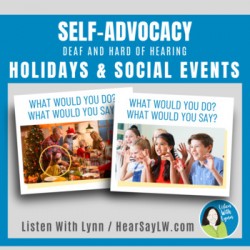

Self-Advocacy Mini Lessons Year Round Holidays and Social Events
$ 7
Ten Self-Advocacy Mini-Lessons with Year-Round Scenarios Featuring Social Events and Settings For Kids That Are Deaf and Hard of Hearing.Each scenario is made up of 3 parts:➼ Part One Real photos illu
...
otos illustrating a challenging listening situation at a celebration, gathering, or holiday event.➼ Part Two Guided questions, talking points, and discussion prompts.➼ Part Three Each scenario has a paired Try This! section with advocacy strategies to guide further learning.★ Digital No-Prep or PlanningEasily used by parents at home, teachers, and therapists both face-to-face and on tele-platforms. When playing on a computer, open and use a PDF reader such as the free Adobe Acrobat Reader DC. It can be opened and played with your favorite PDF reader app on a tablet or on an iPad.◈ ◈ ◈ ◈ ◈ ◈ ◈ ◈ ◈ ◈ ◈ ◈ ◈ ◈ ◈ ◈ ◈ ◈ ◈ ◈ ◈ ◈ ◈ ◈ ◈ ◈ ◈ ◈ ◈ ◈ CUSTOMER TIPS➼ Questions? EMAIL ME before purchasing this resource or anytime later♥ Sign-up HERE for the Listen With Lynn Emails♥ Let’s ConnectInstagramFacebookKeep up your good work. I am blessed to help along the way.Thanks so much!Lynn Wood
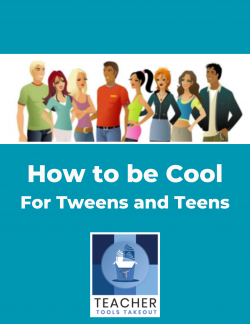
How to be Cool
$ 2
Excellent discussion handout to share with tweens and teens. Based on a study of a group of teens charged with creating a list of what makes individuals 'cool' and more acceptable to peers. Provides i
...
mportant insights about individuality and standing up for who you are and what you believe in.
*BACK TO SCHOOL EDITION* "Ideal" vs. Difficult Listening Scenarios (Self-Advocacy Skills)
$ 375
This resource contains 15 possible listening situations for DHH learners. Read each scenario and have your student decide if this is an "ideal" listening situation or a "difficult" listening situation
...
Advocacy in Action Curriculum guide, worksheets, and assessment tracker for High School - BUNDLE
$ 1295
Complete curriculum guidance and scenarios for instruction in the students involvement in IEP planning, understanding and applying the law, assistive devices, and exploring options after graduation (
...
transitioning into the workplace or postsecondary school). Also includes a a pre and post assessment skills tracker that can be used to determine strengths and needs, track skill acquisition, and create goals and objectives. Includes items 0522, 0532 - 0534, 0536-0539, 0552-0559, 0478, 0479
Advocacy-Adult Perspective-A Foot in Both Worlds (Jason)
$ 2
Expose older students to how self-advocacy skills different from school to adult life. Students are given an article written by an adult with hearing loss. Encourage discussion and forward-thinking wi
...
th this activity. This article deals with developing an identity as a person who is from the Deaf culture or who functions in the world as a hard of hearing communicator. See BUNDLE at S0XSCI729.
Advocacy-Adult Perspective-Advocacy+FM use (Janet, P2)
$ 2
Expose older students to how self-advocacy skills different from school to adult life. Students are given an article written by an adult with hearing loss. Encourage discussion and forward-thinking wi
...
th this activity. This article addresses the advantages of using an FM system in adult situations. See BUNDLE at S0XSCI729.
Advocacy-Adult Perspective-From Denial to Acceptance (Janet)
$ 2
Expose older students to how self-advocacy skills different from school to adult life. Students are given an article written by an adult with hearing loss. Encourage discussion and forward-thinking wi
...
th this activity. This article deals with the process of accepting your own hearing loss. See BUNDLE at S0XSCI729.
Hearing Technology and You - Your Idea of the Perfect Hearing Device
$ 175
Worksheet poses questions for individual or grouPS- of hard of hearing students to discuss regarding their idea of a perfect hearing device and how hearing loss is a part of who they are.
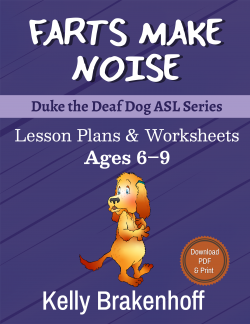
Farts Make Noise (Duke the Deaf Dog ASL Series) Printable Workbook Ages 6-9
$ 799
No prep time, just print and go!Every student needs to learn that some noises are loud, some are quiet, and some noises are not polite. Students will also learn that being deaf or hard of hearing can
...
be positive.Download this complete lesson plan written by a certified Deaf Educator for ages 3 to 5 and Pre-K to K.Seven printable worksheets are included as companions to the picture book: Farts Make Noise (Duke the Deaf Dog ASL Series #2), by Kelly Brakenhoff: two different cover art options, three worksheets, and two coloring pages. Video tutorial links are included for practicing the ASL vocabulary and an ASL version of the complete story performed by a Deaf College Instructor.There are many creative ways to use this workbook in your classroom.Have a small group read the book together, while other small groups are reading a different book. Have the group of students complete the worksheets and discuss their responses to the social emotional aspects of the story. The students can break into pairs to practice the ASL signs used in the book.Have a student read the book independently, complete the worksheets, and view the ASL video tutorials online.Read aloud the story to your class and/or watch the video version of the story in ASL with the link provided. Use the lesson plan and follow the discussion questions with a full class or in smaller groups.This packet is also perfect to supplement homeschooling curriculum.

 Cookies