 Your browser is out of date. For best experience switch to latest updated Browser.
 Get Chrome
 Get Edge
 Get Firefox
Ability Levels
Categories
Resource Types
Age/Grade Range
CCSS
Anchor Standard
Speaking & Listening
Language
Reading
Advocacy In Action Curriuculum guide, worksheets, and Assessment tracker for Middle School - BUNDLE
$ 1695
Complete curriculum guidance, fillable sheets, activities and scenarios for instruction in understanding hearing loss (in themselves and other role models), assistive devices, and social awareness si
...
tuations. Also includes a a pre and post assessment skills tracker that can be used to determine strengths and needs, track skill acquisition, and create goals and objectives. Includes items 0527-0531, 0535, 0539, 0479, 0477
Primary/Elementary Social Situations for Students with Hearing Loss- BUNDLE- Advocacy in Action
$ 195
BUNDLE - Worksheets for primary level instruction on advocating during communication breakdowns. These worksheets guide the student to analyze the communication breakdown and choose an appropriate wa
...
y to repair the breakdown. Bundle IDs 0497-0500, 0524-0525.
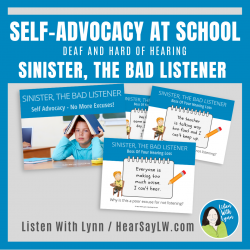
Self-Advocacy Sinister, The Bad Listener
$ 5
This resource is a hilarious self-advocacy activity. Your students will say it is their favorite activity and, you will know they are learning to become the boss of their hearing loss. It was created
...
to encourage self-advocacy skills in children who are deaf and hard of hearing but is effective when targeting listening skills in all kids.The Premise: Sinister has two ears, wears great hearing devices, and has been in listening and language therapy since he was a toddler. But, it doesn’t matter. Sinister is a BAD listener! He doesn’t try and makes up excuses for not listening. Sinister gets in a whole lot of trouble because he doesn’t listen.The adult leads a discussion using Sinister’s poor excuses for not listening. Kids love imagining the trouble Sinister gets himself into because he doesn’t listen. This activity is an easy, no-prep way to encourage the child to be Boss of Your Hearing Loss. Parents can use it at home, teachers and therapists both face-to-face and during tele-practice. While not age-specific it has been successfully used with kids in 1st grade and up through middle school. This resource can be easily leveled up or down to meet various children's goals and needs.Sinister The Bad Listener requires no prep or planning because everything is in this resource. It can be easily used by parents at home, teachers, and therapists both face-to-face and on tele-platforms. This Digital - No Print resource can be opened and played with your favorite PDF reader app on a tablet. When playing on a computer, open and use a PDF reader such as the free Adobe Acrobat Reader DC. Boom LearningSinister the Bad Listener is also available as a Boom Deck in the Listen With Lynn Boom Learning store. Please note: Sinister The Bad Listener is a serve-and-return conversational game between the adult and the listener. There is no audio component or sound bytes included.◈ ◈ ◈ ◈ ◈ ◈ ◈ ◈ ◈ ◈ ◈ ◈ ◈ ◈ ◈ ◈ ◈ ◈ ◈ ◈ ◈ ◈ ◈ ◈ ◈ ◈ ◈ ◈ ◈ ◈ ◈ ◈You'll love all these resources for kids with hearing loss and self-advocacy activities!❤ ❤ Check out the Bundle of 8 Self-Advocacy $$ saving bundle! SELF-ADVOCACY Tips For Communication Success (Free)SELF-ADVOCACY The 5 L's For Listening (Free)SELF-ADVOCACY This or That?SELF-ADVOCACY Bluffing Never Have I Ever ActivitySELF-ADVOCACY Role Play Real-Life ConnectionsSELF-ADVOCACY Scenarios At Group Gatherings & CelebrationsSELF-ADVOCACY Sinister The Bad ListenerSELF-ADVOCACY Scenarios - Turning Lemons Into LemonadeSELF-ADVOCACY Perk Up Your Ears (Ear-related sayings and idioms)SELF-ADVOCACY Listen & Draw Directions◈ ◈ ◈ ◈ ◈ ◈ ◈ ◈ ◈ ◈ ◈ ◈ ◈ ◈ ◈ ◈ ◈ ◈ ◈ ◈ ◈ ◈ ◈ ◈ CUSTOMER TIPS:➼ Click here to stay updated!➼ Be the first to know about freebies, sales, and product launches.➼ New products are 50% off the first 24 hours
STAY CONNECTED:✧ Sign-up here for the Listen With Lynn Email✧ Follow on Facebook
✧ Follow on Instagram
✧ Feel free to email me with questions, before purchasing this resource or anytime later.
❤ Keep up your excellent work. I am blessed to help along the way. Thanks so much! Lynn

"The Sky's The Limit"
$ 299
A collection of comic strips revealing troublesome situations for teens with hearing loss. Includes commentary on how each humorous situation might be resolved.
...

CAVE Checklist - Communication Access in Virtual Education (Spanish)
$ 0
The CAVE Checklist in Spanish is a self-report checklist is intended to be completed students age 9 and above who are deaf or hard of hearing to identify possible communication access issues that may
...
occur during virtual education situations. It is recommended that the CAVE be completed in an interview format with the DHH specialist discussing each situation with the student. Students read 10 questions related to accessing communication in online learning situations and rate them from Always Easy to Always Difficult, or Doesn't Happen. A total score can be obtained. Not every situation will apply to every student. Situations indicating appropriate access will receive scores of 4 or 5. Items scoring 1, 2, 3, need to be addressed for appropriate access needs. The 10 questions are followed by a list in which the student identifies what he or she thinks helps most during online learning.
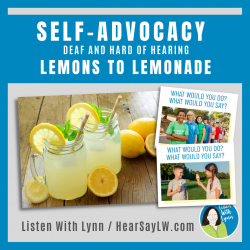
Self Advocacy Scenarios TURNING LEMONS INTO LEMONADE
$ 7
20 Real-Life Scenarios portray common situations encountered by school-aged children who are deaf and hard of hearing. They are derived from true stories I have heard from children over the
...
years. The scenarios are of real photos that elicit language and engagement.Discussion prompts are included with each scenario and include guidance for the therapist, teacher or parent to incorporate when leading the discussions. The scenarios foster problem solving and brainstorming for possible solutions for each difficult communication situation.When Life Gives You Lemons, Make Lemonade - While the theme is lemons the scenarios are common listening situations where problems may occur due to the setting, the listener or the person talking.A scaffolding strategy, I find successful when introducing self-advocacy begins with an experiential language activity of making homemade lemonade. This rich experience sets a foundation for an ongoing series of lessons on self-advocacy and the premise of this resource. Children in my practice learn early, they are the boss of their hearing loss. Sometimes life hands them sour lemons but they can choose to turn those lemons into sweet lemonade.Digital - No PrintInteractive PDF with clickable buttons to navigate between pages.Teletherapy and as no print in face-to-face lessons/sessions.Read more on the HearSayLW blog. Any questions? I'm a great listener.◈ ◈ ◈ ◈ ◈ ◈ ◈ ◈ ◈ ◈ ◈ ◈ ◈ ◈ ◈ ◈ ◈ ◈ ◈ ◈ ◈ ◈ ◈ ◈ ◈ ◈ ◈ ◈ ◈ ◈ ◈ ◈ ◈ ◈CUSTOMER TIPS:➼ Questions? Feel free to email me before purchasing this resource or anytime later. ➼ Sign-up HERE for the Listen With Lynn NewsletterLet’s Connect:InstagramFacebookKeep up your good work. I am blessed to help along the way. Thanks so much! Lynn
Advocacy in Action Curriculum Lower Elementary
$ 7
Complete curriculum guidance and scenarios for instruction in amplification (including hearing aids, cochlear implants, and FM systems), listening environments, and social awareness situations.
Advocacy in Action Curriculum Upper Elementary
$ 13
Complete curriculum guidance and scenarios for instruction in amplification (including hearing aids, cochlear implants, and FM systems), hearing loss basics including audiograms and ear anatomy, liste
...
ning environments, and social awareness situations.

Self-Advocacy - Preparing for Fall
$ 0
Information and ideas to prepare your students for a great start to the year!
Meeting the Challenge - Keeping Hearing Devices on Young Children - Preschool: 2-5 yrs. old
$ 0
Brochure specifying what makes it challenging to keep hearing aids on 2-5 yrs old, why hearing aids are needed, and strategies to help keep them on, including hearing aid retention devices.

 Cookies