 Your browser is out of date. For best experience switch to latest updated Browser.
 Get Chrome
 Get Edge
 Get Firefox
Ability Levels
Categories
Resource Types
Age/Grade Range
CCSS
Anchor Standard
Speaking & Listening
Language
Reading
Performing the Ling Sound Listening Check in Preschool
$ 195
This handout describes how to perform the Ling sound listening check in the preschool or early childhood classroom setting.

Beyond the Sky’s Limit
$ 299
A collection of comic strips revealing troublesome situations for teens with hearing loss. Includes commentary on how each humorous situation might be resolved.20 more situations and scenarios that m
...
mix humor with compassion in negotiating social communication.More antics and advocacy for teens and tweens with hearing loss.
Auditory Objectives During ELA: Compound Words
$ 295
Describes auditory components of compound words.Data collection sheet and materials for discrimination of auditory discrimination between compound and non compound 2-syllable words. Go Fish game to ma
...
tch 20 compound word cards and definition cards. Suggestions for differentiation. Activities conducted through listening, without print.
Targeting Phonics & Word Recognition Skills
$ 195
Support development of foundational reading skills with activities and materials to practice: 1) vowel perception in isolation and in words, phoneme blending and sound-letter association; 2) discrimin
...
ation of vowels in words, sorting long & short vowels.
Detection of /s/ in Sentences
$ 195
Strategies and activities for detecting /s/ in words within sentences. Includes a fillable sheet and scripts for activities.
Listening Development Profile
$ 195
The Listening Development Profile allows the DHH specialist to rate aspects of student behavior as a beginning listener, intermediate listener, and advanced listener. Reflects the hierarchy of auditor
...
y development.
FAPI - Functional Auditory Performance Indicators
$ 0
FAPI - Functional Auditory Performance Indicators: An Integrated Approach to Auditory Skill Development. The FAPI assesses the functional auditory skills of children with hearing loss. It can be used
...
by parents, therapists, early interventionists, and teachers. The profile lists auditory skills in an integrated hierarchical order with seven categories. Word version
Performing the Ling Sound Listening Check
$ 495
Detailed description and strategies for why, when, how, who hearing aids should be monitored for infants and toddlers with hearing loss.
Activities for Listenings and Learning - ALL (fillable)
$ 295
ALL - Performance Checklist for Development of Complex Listening Skills. Provides a list of Listening, Communication, and Learning Skills with spaces to complete progress. Areas: auditory association,
...
discrimination, memory, closure, humor, etc.
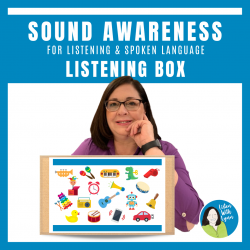
A Listening Box DIY For Sound Awareness
$ 3
A LISTENING BOX is a must-have tool if you guide families of young children who are deaf and hard of hearing. A Listening Box is fun and colorful. It holds sound-making toys, objects, and toy instrume
...
truments in order to present the sound through hearing first. The sound-making objects are hidden behind the Listening Box’s lid which little kids love. This Learning To Listen activity helps a child develop sound awareness and attach meaning to speech and environmental sounds. It is a classic Listening and Spoken Language Auditory Verbal activity for beginner listeners.DIY In one of my early intervention auditory verbal sessions with the parents or caregivers we make a DIY Listening Box together either face to face or in a teletherapy session. It gives us time to chat when I can offer important information about sound awareness and listening and spoken language outcomes.This resource includes:✧ Auditory targets for showing awareness of meaningful indoor and outdoor environmental sounds, music, and speech✧ Direction to make a Listening Box* with your own cardboard box with a lid✧ Colorful printable graphics for multiple-size boxes✧ 8 Tips for using a Listening Box✧ Recommendations of musical toys, noisemakers, and Learning to Listen Sound Association Objects to fill the box.*Box and toys not included.On the blog: DIY Listening Box◈ ◈ ◈ ◈ ◈ ◈ ◈ ◈ ◈ ◈ ◈ ◈ ◈ ◈ ◈ ◈ ◈ ◈ ◈ ◈ ◈ ◈ ◈ ◈ ◈ ◈ ◈ CUSTOMER TIPS:➼ Questions? Email me before purchasing this resource or anytime later.♥ Sign-up HERE for the Listen With Lynn Newsletter♥ Let’s Connect:InstagramFacebookKeep up your good work. I am blessed to help along the way. Thanks so much!Lynn

 Cookies