 Your browser is out of date. For best experience switch to latest updated Browser.
 Get Chrome
 Get Edge
 Get Firefox
Ability Levels
Categories
Resource Types
Age/Grade Range
CCSS
Anchor Standard
Speaking & Listening
Language
Reading
My FM-DM-HAT System Advocacy in Action
$ 1
Worksheet for students to draw their Hearing Assistance Technology (HAT) system and name the parts.
Hearing Tech - Personal Hearing Technologies
$ 2
Describes several different types of hearing devices including hearing aids, bone conduction amplification, cochlear implants, and personal DM/FM systems. Gives information on 'bling' for hearing devi
...
ces.
Hearing Tech - Consistent Hearing Aid Use
$ 2
Explains the math of wearing hearing aids and how consistent use benefits the student, especially in school. Includes a fillable, daily monitoring documentation sheet for younger students.
Social Skill Areas - Definitions and Critera
$ 0
The four major social skill areas are defined and operationalized for elementary and secondary learners: compliment, questions, small talk, and criticisms. It is followed by extensive examples of how
...
to elicit social responses from students.
The Secondary School Survey and Discussion
$ 295
This survey is appropriate for tweens and teens, especially those who are B to resist using hearing aids. It asks questions about how students feel about their hearing loss, hearing devices, and commu
...
nication with hearing loss. Once the student completes the survey their responses can be compared with a large group of students with hearing loss. Provides discussion questions.
Assistive Devices I Will Use - Advocacy in Action
$ 1
Worksheet in which students describe different assistive devices, use for the device, place to obtain, cost, etc. Students develop a reference for themselves for post-high school communication situati
...
ons.
Attitude is Caught, Not Taught for Families
$ 0
This is a powerful handout Attitude is Caught, Not Taught which sheds light on how parent behavior helps shape child attitudes toward hearing aid use and hearing loss.
Speech Audibility Audiogram for Classroom Listening (fillable)
$ 2
The SpeECH- Audibility Audiogram for Classroom Listening is based on the Count-the-Dot Audiogram and provides an estimate of percent audibility in quiet and noise for different ranges of hearing loss.
...
It is most appropriate to use for flat hearing loss. Can be paired with FLE and audiological evaluation information to inform on the impact of hearing loss for speECH- perception in the classroom. Use described in the free article: S0XTEA0396
Hearing Tech - Remote Learning Technology and Face Coverings
$ 0
This
article reviews various online learning platforms, video conferencing tools,
captioning options, and resources related to use of face masks for students
with hearing loss. It i
...
ncludes Top 10
Tips for Ensuring Access for Your Hard of Hearing Student, which is
applicable to any learning setting, with or without masks!
Do Teachers Really Need a Microphone?
$ 150
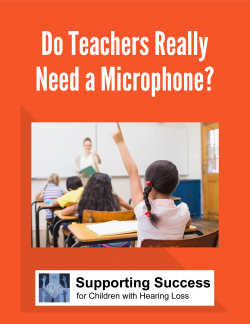
Teachers who have not had experience with students who are hard of hearing are usually unused to wearing a microphone transmitter and often ask, "Do I really Need a Microphone?" This brief information
...
al article describes how hearing technologies are essential tools for learning.

 Cookies