 Your browser is out of date. For best experience switch to latest updated Browser.
 Get Chrome
 Get Edge
 Get Firefox
Ability Levels
Categories
Resource Types
Age/Grade Range
CCSS
Anchor Standard
Speaking & Listening
Language
Reading
Pretest for Articles and Conjunctions - CGC
$ 0
Articles and Conjunctions Pretests - Free functional assessment pre-tests of the areas of articles and conjunctions knowledge. Each pre-test has a cut off score criteria, targeted intervention goals,
...
and recommends which Cracking the Grammar Code teaching materials to use to begin instruction. Includes key to all pre-tests.
Assessment - Disability Identity Development Model
$ 295
Gibson's Identity Model is explained in three stages. Students are asked to rate each of the statements about their hearing loss, feelings about fitting in, and how they self-identify. Fillable form.
End of the Year Vocabulary Exposure Challenge
$ 5
We all know that our DHH learners need to be taught vocabulary intentionally for a number of reasons. We also know that students need to be exposed to vocabulary words several times in order for them
...
to internalize them. Vocabulary development is a crucial skill for our DHH learners. I created this resource for teachers to provide to families and/or older students during summer break.Encourage families to join this vocabulary exposure challenge over the summer! This resource contains 7 summer-themed word lists that can be given to families and students. Challenge families to take action and pick at least one word per day to use with their DHH learner in context. Have the families talk about the words with the students. Or, you can encourage your older students to pick one word a day to use and look up. Along with the lists, there is a chart that can be used to track the words that are used weekly.This could also be used as a resource for ELL learners or enrichment for students.
COMPASS - Test Recording Form (fillable)
$ 0
COMPASS Test of Auditory Discrimination by David Sindrey. Test Recording Form
SDLMI - Elementary Student Evaluation Tool
$ 0
Checklist for late elementary and middle school students regarding knowing own needs and strategies to reach goals. From Kansas University Center on Developmental Disabilities.
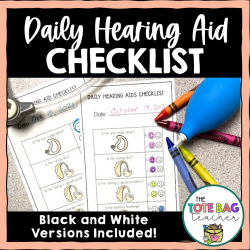
Daily Hearing Aid Checklist
$ 2
This daily hearing aid checklist is perfect for little learners as they grow in their self-advocacy skills. This set features both color and black & white versions, along with an option for one hearin
...
g aid or bilateral hearing aids. Either print for daily use, or for an easier option, print and laminate to reuse with a dry erase marker. If you find this resource helpful for your students, please consider rating it. I greatly appreciate the feedback from my fellow teachers. Thank you!
My Child Has Permanent Hearing Loss: Now What?
$ 0
Once a child is diagnosed with hearing loss family members have many questions. This resource provides information addressing how overwhelming the diagnosis can be and families may have many feelings
...
about the testing process and the diagnosis. It describes where you can find help and support and why it is important to start services shortly after the hearing loss is diagnosed.
LIFE-R Classroom Teacher Accommodation Suggestions based on responses to Student Appraisal
$ 3
Listening Inventory For Education - Revised crosswalk of specific self-advocacy questions and accommodations for each situation.

CHILD checklist for families to complete - Children's Home Inventory of Listening Difficulties - fillable
$ 250
Family Checklist - 15 questions about listening in home and community situations. 8-point rating scale (Understand-O-Meter). Listening Situation Breakdown resulting in scores for Quiet, Noise, Distanc
...
e, Social and Media.
FAPI - Functional Auditory Performance Indicators
$ 0
FAPI - Functional Auditory Performance Indicators: An Integrated Approach to Auditory Skill Development. The FAPI assesses the functional auditory skills of children with hearing loss. It can be used
...
by parents, therapists, early interventionists, and teachers. The profile lists auditory skills in an integrated hierarchical order with seven categories. Word version

 Cookies