 Your browser is out of date. For best experience switch to latest updated Browser.
 Get Chrome
 Get Edge
 Get Firefox
Ability Levels
Categories
Resource Types
Age/Grade Range
CCSS
Anchor Standard
Speaking & Listening
Language
Reading

Preparing Students for an Audiology Appointment-Printable Activity (Deaf Education/Advocacy)
$ 350
Help to prepare your students for the audiologist with this quick activity.This activity contains two checklists that can be reviewed and completed with students prior to their appointment with the au
...
diologist. The checklists discuss possible topics and concerns related to their hearing or devices, as well as questions regarding any equipment needs that they may be encountering.There are two forms for you to choose from. One is geared toward students who need more language support, and the other form encourages more independence and is geared for older students.Completing this activity with students will help to prepare them for their appointment, along with further developing their self-advocacy skills related to their hearing loss. It will also assist them in becoming more familiar with some concepts and vocabulary that are related to the audiology appointment. Give your students the opportunity to express their needs and to feel empowered by being actively involved in their hearing health!
Sub Folder Letter for Explaining Sound Field *FREEBIE*
$ 0
Print this letter to share with classroom teachers during your inservices. Ask them to add the letter to their sub folders in order to encourage continuity of use for the sound field system
...

DHH Social Story: When My Nose Runs
$ 450
Additional Comprehension ActivitiesReading Comprehension QuestionsLists of tier 1 + 2 related vocabGame board to make it fun or help that wiggly off-task child stay focusedNew Concept for Older Kids:
...
What are “endonyms”This is a story to help children/students who wear hearing aids understand why they may go to the doctor and/or ENT more often than others. The story can be read for comprehension. It teaches new vocabulary and creates a wonderful language opportunity for students to better advocate for themselves at school, home, and the doctor/ENT office. This story was written with younger children and their families and older students who continue to come to school with blocked hearing aids and do not use an interpreter for language access.Service Activity for EI-ECSE Families & Home VisitsFor any family, this story can be an important conversation starter, or reminder, to understand the language impact of even partially clogged hearing aids for their kid(s) who are not using signs. This can be demonstrated to parents by using a listening tube when their child’s hearing aid is plugged in and cleaned, and then having them listen again to the difference in clarity of language coming through the hearing aid to their child’s brain.Story Printable OptionPrint each two-page spread in landscape mode OR - Print a two-page spread but cut apart pages to show 1 page at a time. Spiral bind, 3-hole punch, or staple.Interactive Digital OptionPresent the book on a device or overhead projector. To play the digital version of the game, click on the digital spinner link. Change the spinner to “3” numbers. Pick & move game pieces (pink, green, blue)QuestionsUse professional judgment when deciding on which comprehension questions to ask the student. *The advanced questions are marked with an * following the number.VocabularyTier 1 vocabulary Tier 2 vocabulary prefix Endonyms short nonfiction passage Endonym Activity Options ask students to research endonyms related to sick words show sick examples and ask them to find more

Social Story: How To Clean Your Hearing Aids
$ 2
This was created with a student for students, staff, and families of children who wear hearing aids. Cleaning hearing aids regularly means checking the hearing aids weekly. Cleaning as often as week
...
ly for some children and for some specific times of the year.
Self-Advocacy Scenarios for Middle/High School Students
$ 5
This product contains 20 realistic scenarios to review and discuss with your middle school or high school students who are deaf/hard-of-hearing. These scenarios focus on self-advocacy challenges that
...
are related to academics, socialization, equipment issues, and accommodations.You can use this as digital or printed resource!Please leave a review and let me know what you think! I hope that this is helpful to you!

Remote Microphone (Touchscreen) Visual Reminder Printables
$ 150
Who else has students that forget their remote microphones when going from class to class?This product has two different-sized options to print and use for your students who may need a visual reminder
...
to bring their remote microphone with them. There is a full page reminder, and an additional page that has four smaller-sized reminders.The image is of a touch screen remote microphone.
An SLP's Guide to D/HH students
$ 5
This infographic is a reference guide for speech-language pathologists and other professionals to gain insight about the layers of unique communication needs for children and students with hearing dif
...
ferences. Explore the functions of Listening, Language and Speech and what different levels of hearing function might mean for those students. Additionally, there are 4 core areas that research suggests are areas of difficulty for individuals with hearing differences. Download this resource guide as a road map to evaluation and treatment when working with this population.
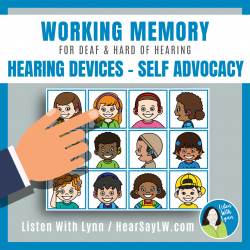
Hearing Devices - Self Advocacy Working Memory
$ 2
If you have students who are deaf and hard of hearing that need help with auditory working memory, executive functioning, and following directions, this Listening Finger Walk is a must-have! It builds
...
lds vocabulary about types of hearing loss and hearing devices. It boosts confidence and helps children feel good about their own hearing technology. It's fun for the kids and a simple no-prep resource for you. Just open the PDF on your screen or print it and go!The colorful playing board features 16 children wearing hearing devices like hearing aids, cochlear implants, and bone-anchored hearing systems. You can target vocabulary like unilateral, bilateral, behind-the-ear, in-the-ear, earmolds, processor, headpiece, magnet, coil, microphone, and more.This Listening Finger Walk:➼ helps build listening skills and working memory by allowing kids to work with auditory information without losing track of what they're doing.➼ targets vocabulary, descriptive skills, spoken language, and communication skills.➼ has three rounds that each increase in auditory complexity.Includes:✧ A Hearing technology or devices theme for therapy sessions or school lessons✧ Listening and Spoken Language Tips✧ Print Version: Easy print and go!✧ Digital Version No Prep Ready to screen sharePlease Note: This activity and the Positive Self-Concept Auditory Learning Games contain similar images of the same children. The resources both target self-advocacy but have different auditory and language-based goals. You will want both resources you will want in your Summer Toolbox.◈ ◈ ◈ ◈ ◈ ◈ ◈ ◈ ◈ ◈ ◈ ◈ ◈ ◈ ◈ ◈ ◈ ◈ ◈ ◈ ◈ ◈ ◈ ◈ ◈ ◈ ◈ ◈ ◈ ◈ CUSTOMER TIPS:➼ Questions? EMAIL ME before purchasing this resource or anytime later♥ ♥ ♥ Sign-up HERE for the Listen With Lynn Emails♥ Let’s Connect:InstagramFacebookKeep up your excellent work. I am blessed to help along the way.Thanks so much!Lynn Wood

Self-Advocacy for Young DHH Learners: Scripts for Communication Repair (Part 2)
$ 350
Teaching self-advocacy is SO IMPORTANT for our young learners who are deaf/hard-of-hearing. Over the years, I have found that even though we can teach the skills, we must also focus on teaching the la
...
nguage that is needed to complete the skills.This product contains 15 NEW difficult listening scenarios/communication repair scenarios and possible responses geared toward younger students. Each page contains a simple scenario, and then provides two possible responses for the student to choose from. Some of the responses also offer you the opportunity to use scaffolding, depending on the needs and abilities of your students.These scenarios also work well for students who have lower language abilities!Your students will have fun role-playing these scenarios with you while learning appropriate and effective ways to seek out assistance that they may need in an educational setting.
Self-Advocacy True/False Activity
$ 350
This product contained 20 statements in flashcard form focusing on self-advocacy skills. You can use this as a fun end of the year activity or even as an assessment to gauge your student's understand
...
ding of self-advocacy skills. This would also be an excellent way to reinforce/support the difficult concept of "true or false" with your students.Read each statement to the student. Ask them to decide if the statement is "true" or "false."

 Cookies