 Your browser is out of date. For best experience switch to latest updated Browser.
 Get Chrome
 Get Edge
 Get Firefox
Ability Levels
Categories
Resource Types
Age/Grade Range
CCSS
Anchor Standard
Speaking & Listening
Language
Reading
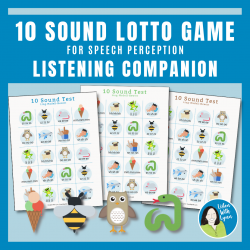
LOTTO 10 Sound Game Companion LMH Speech Perception
$ 4
You asked for a way to practice the LMH 10 Sounds and I listened! This Lotto Game Companion is an engaging way for children with hearing loss to listen, learn, and identify the sounds while practicing
...
cticing speech perception!This is a one-time print-and-go activity that can be used day after day!Lotto Game Includes:Six different game cards20 spaces on the Lotto cardsTen colorful calling cardsEach of the 10 Sounds is represented. The LMH 10 Sound Screening Test is a free resource in my store. The LMH test is a screening test to be used by parents and clinicians working with children with hearing loss.August 2021: Permission was granted electronically by the authors Madell and Hewitt to produce this resource and the images were approved.L ➼ Ling - LowM ➼ Madell - MidH ➼ Hewitt - HighCUSTOMER TIPS:➼ Questions? Email me before purchasing this resource or anytime later.STAY CONNECTED:✧ Sign-up here for the Listen With Lynn emails✧ Follow on Facebook - Lynn A. Wood - LSL Auditory Verbal Therapist and Rehab Audiologist✧ Follow on Instagram @auditoryverbal_listenwithlynn❤ Keep up your excellent work. I am blessed to help along the way. Thanks so much!Lynn Wood
Project Planner - Lower Elementary - Advocacy in Action
$ 125
Culminating project in which the student reports how they care for their hearing aid or cochlear implant and FM/DM system, challenging listening situations, and knowledge of hearing loss. Includes an
...
example of a book a student would create with illustrations and answers to the questions in the project planner.
A Day with My FM System - Advocacy in Action
$ 1
Worksheet for students to complete their daily routine in using and caring for their FM / DM / HAT system. Fillable.

New Teacher Bundle
$ 40
The New Teacher resource is an invaluable bundle packed with information you can use to explain the impact of hearing loss to your student's teachers and parents. 30 pages of resources. The New Teach
...
acher Combo includes:1. Impact of Hearing Loss on Listening, Learning, and Social Interactions (5 pages)2. Emailable, computer fillable SIFTERs (Preschool, Elementary, Secondary) (6 pages)3. Emailable, computer fillable LIFE-R Teacher Appraisal (2 pages)4. Emailable, computer fillable Access to Curriculum Inventory (ATCI) for General Education Teacher (3 pages)5. Children with Hearing Loss Miss More Than You Think (1 page)6. Listening Comprehension Exercise – Mother’s Aprons (1 page)7. Barriers to Listening – Visual analogies of listening in noise, reverberation, and distance (5 pages)8. Student Listening Challenges – Understanding the Missing Pieces (1 page)9. Attitude is Caught, Not Taught (teacher version) (1 page)10. Hearing Aid/Cochlear Implant Monitoring and the Law (1 page)11. Hearing Aid Monitoring – An Important Daily Activity (4 pages)12. Emailable Tips for Teachers (Early Childhood + K-12) Word version (15 pages)
Audiology Self-Advocacy Checklist - Elementary School (ASAC-ES)
$ 0
Checklist identifying student skills and knowledge about hearing loss, audiogram, amplification, and successful communication in the classroom. For elementary age students
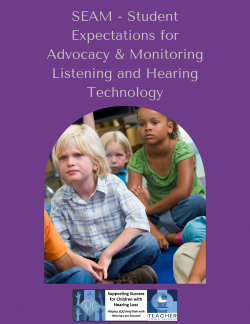
SEAM - Student Expectations for Advocacy & Monitoring Listening and Hearing Technology
$ 3
The SEAM lists expected student skills from Preschool through High School for hearing tECH-nology use, involvement in monitoring, and self-advocacy skills. Useful for functional assessment and goal wr
...
iting.
Primary/Elementary Listening Situations for Students with Hearing Loss- BUNDLE - Advocacy in Action
$ 395
BUNDLE - Worksheets for primary level instruction on advocating for better hearing during a variety of listening situations. These worksheets guide the student to analyze the listening environment an
...
d make changes for better hearing. Bundle IDs 0492-0496, 0520-0523.
Hearing Aid Reward Chart - Advocacy in Action
$ 1
Chart used to mark each time the student wears hearing aids to school or successfully checks hearing aid function. Large space to allow for sticker, stamp, or mark in reward.
Cochlear Implant Reward Chart - Advocacy in Action
$ 1
Chart used to mark each time the student wears cochlear implants to school or successfully checks implant function. Large space to allow for sticker, stamp, or mark in reward.
I Can Check It! Cochlear Implants - Advocacy in Action
$ 1
Worksheet for young students to check off A) does the battery work? B) is it on the correct channel C) did I put the magnet in the right place? D) can I hear the teacher? Large spaces for students to
...
mark or stamp. One worksheet to be used each week. Fillable.

 Cookies