 Your browser is out of date. For best experience switch to latest updated Browser.
 Get Chrome
 Get Edge
 Get Firefox
Ability Levels
Categories
Resource Types
Age/Grade Range
CCSS
Anchor Standard
Speaking & Listening
Language
Reading
Self-Advocacy Scenarios: "Ideal" vs. "Difficult" Listening Scenarios (End of the Year and Summer-Themed)
$ 375
This self-advocacy product contains 15 possible scenarios that students could face as a learner who is deaf/hard-of-hearing. The scenarios are end of the year and summer-themed situations. Read each s
...
scenario with your students. Have your students decide if it is an "ideal" listening situation or a "difficult" listening situation.
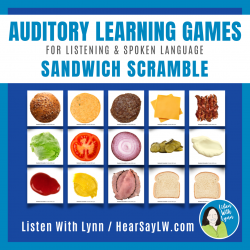
SANDWICH SCRAMBLE 5 Ways to Play Game Listening and Language
$ 5
Sandwich Scramble is a fun, flexible, and engaging listening and spoken language resource. Players listen, play, and talk while scrambling to make burgers and sandwiches. It can be played again and ag
...
again with many kids and goals across your whole caseload. It's easy for you with a one-time prep.➼ Children have a blast and don’t realize they are following and giving directions, learning spatial and temporal concepts, vocabulary, auditory memory, comprehension, and sequencing skills. Sandwich Scramble grows social skills and kids learn turn-taking, problem-solving, and self-advocacy while role-playing. ➼ Sandwich Scramble is a flexible resource. Play using all the cards, sort out a smaller set, or simplify the directions. It is easy to level up or down the directions to meet a child’s needs and goals.ONE PRODUCT - FIVE GAMES OR WAYS TO PLAYSandwich Scramble targets auditory goals that relate to following directions:✧ GAME 1: Highlights temporal concepts and sequencing.✧ GAME 2: Targets critical elements and complex directions.✧ GAME 3: Focuses on spatial relationships.✧ GAME 4: Role-playing turn-taking, problem-solving skills social, pragmatic,and self-advocacy skills.✧ GAME 5: Auditory comprehension and listening for detailINCLUDES:➼ A guide with instructions ➼ 16 Large colorful mix-and-match sandwich/burger ingredients and a digital pdf PDF for screen sharing➼ 5 games with examples➼ Lesson expansion ideas with read-aloud story suggestions➼ Listening and spoken language (LSL) TipsIDEAL FOR: Listening & Spoken Language, Deaf & Hard of Hearing, Auditory Processing Disorder, Speech and Language Therapy, School Lessons, Auditory Verbal Sessions, Homeschoolers, TeletherapyFACE TO FACE - TELETHERAPY - HOME✢ PRINT - One-time easy prep and use time and time again✢ DIGITAL - The digital page can be opened and played with your favorite PDF reader app on a tablet or iPad. Tokens can be placed directly on the screen.- On a computer open the PDF with the sandwich ingredients and use a PDF reader such as Adobe Acrobat Reader DC which is free. The listener can use the annotation tools to mark the card.◈ ◈ ◈ ◈ ◈ ◈ ◈ ◈ ◈ ◈ ◈ ◈ ◈ ◈ ◈ ◈ ◈ ◈ ◈ ◈ ◈ ◈ ◈ ◈ ◈ ◈ ◈ ◈ ◈ ◈ CUSTOMER TIPS:➼ Questions? Email me before purchasing this resource or anytime later.♥ Sign-up HERE for the Listen With Lynn Emails♥ Let’s Connect:InstagramFacebookKeep up your good work. I am blessed to help along the way. Thanks so much!Lynn
Asking Questions
$ 195
These activities focus on encouraging students to be curious; asking questions to get more information rather than worry about syntactical correctness. Worksheets include: Make up a story using who,
...
what, why, where, and how picture cards; asking questions board game; asking questions in an interview and writing summary of responses; asking why questions - and seeking answers - about the world around us
Social Skills & Empathy
$ 225
Feeling empathy for another person is the ability to share or understand his or her feelings. This article discusses how children learn empathy and provides instructional strategies and activities for
...
teaching students to respond with appropriate empathy.
Speaking Up and Being Scared, or Being Prepared?
$ 250
Introductory discussion followed by 4 activities and a post test. Designed to increase student confidence in participating in the classroom and socially.
Self-Advocacy: End of the Year Paired Reflections for Student and DHH Teacher
$ 2
This no-prep activity is ideal to use at the end of the school year with your deaf or hard-of-hearing students. Use this resource as an opportunity to reflect on the school year, your student's growth
...
and needs, and your own growth and needs as a teacher as well. Having an open dialogue with your student using these guiding questions will help you to understand how you can further support them as a Teacher of the Deaf and Hard-of-Hearing.This resource contains a reflection pages students to complete, a reflection page for teachers to complete, and a supports page for both to complete together.
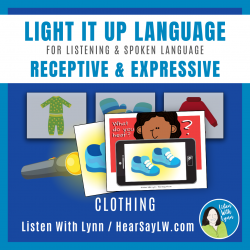
CLOTHING Auditory Processing Receptive & Expressive Language
$ 5
You'll love the CLOTHING version of Light It Up Language! Kids listen to clues presented through hearing alone to identify 16 hidden CLOTHING vocabulary pictures. Each of the pictures has four clues t
...
ues that are increasingly more specific.The magic happens by lighting up the “What Do You Hear?” cards. Hidden pictures are held up to a flashlight and the CLOTHING images amazingly appear. How fun! Once the hidden picture is revealed the child recalls and uses the clues to describe the CLOTHING. Thereby stretching their auditory memory, descriptive language, and expressive language skills.TARGETS: RECEPTIVE: This game builds critical thinking and reasoning skills by categorizing, making inferences, and drawing conclusions. EXPRESSIVE: The child recalls and uses clues to describe the hidden object. INCLUDES:✧ Listening & language guide with instructions✧ Target or goal suggestions✧ 8 What Do You Hear? cards (printed twice)✧ 16 Hidden CLOTHING Picture Vocabulary Cards✧ 64 Prompt Clues - 16 objects with four details each that get increasingly more specific✧ A Script with scaffolding strategies✧ Listening and Spoken Language Tips ➼ EASY one-time quick game prep and you're all set to use year after year. ➼ You’ll need a FLASHLIGHT, a lamp, or a sunny window.◈ ◈ ◈ ◈ ◈ ◈ ◈ ◈ ◈ ◈ ◈ ◈ ◈ ◈ ◈ ◈ ◈ ◈ ◈ ◈ ◈ CUSTOMER TIPS:➼ Questions? Please email me before purchasing this resource or anytime later.♥ Sign-up HERE for the Listen With Lynn emails♥ For more ideas visit my blog: HearSayLW.comSTAY CONNECTED:✧ Sign-up here for the Listen With Lynn emails✧ Follow on Facebook - Lynn A. Wood - LSL Auditory Verbal Therapist and Rehab Audiologist✧ Follow on Instagram @auditoryverbal_listenwithlynn❤ Keep up your excellent work. I am blessed to help along the way. Thanks so much!Lynn Wood
Instructional Strategy - Cooperative Learning
$ 295
For students who are deaf or hard of hearing, this instructional model is a challenge. This article will discuss aspects of cooperative learning and look at ways to improve access and increasing profi
...
ciency in communication while in a cooperative learning situation. Includes fillable worksheet activities and rubric to use in group learning.
"Ideal" vs. "Difficult" Listening Scenarios Part 2
$ 375
This product contains 15 self-advocacy scenarios for geared to help deaf and hard-of-hearing students. There are both "ideal" listening situations and "difficult" listening situations included in orde
...
r to help students develop self-advocacy and problem solving skills.Read each scenario and ask your student to determine if is an "ideal" listening situation or a "difficult" listening situation. If it is a difficult situation, what can be done to fix it?This product is best used with students who are in upper elementary grades and up. It contains both school-based and community-based scenarios.

CAVE Checklist - Communication Access in Virtual Education (Fillable)
$ 2
The CAVE Checklist (Fillable Version) is a self-report checklist is intended to be completed students age 9 and above who are deaf or hard of hearing to identify possible communication access issues t
...
hat may occur during virtual education situations. It is recommended that the CAVE be completed in an interview format with the DHH specialist discussing each situation with the student. Students read 10 questions related to accessing communication in online learning situations and rate them from Always Easy to Always Difficult, or Doesn't Happen. A total score can be obtained. Not every situation will apply to every student. Situations indicating appropriate access will receive scores of 4 or 5. Items scoring 1, 2, 3, need to be addressed for appropriate access needs. The 10 questions are followed by a list in which the student identifies what he or she thinks helps most during online learning.

 Cookies