 Your browser is out of date. For best experience switch to latest updated Browser.
 Get Chrome
 Get Edge
 Get Firefox
Ability Levels
Categories
Resource Types
Age/Grade Range
CCSS
Anchor Standard
Speaking & Listening
Language
Reading

CAVE Checklist - Communication Access in Virtual Education (English)
$ 0
The CAVE Checklist is a self-report checklist is intended to be completed students age 9 and above who are deaf or hard of hearing to identify possible communication access issues that may occur durin
...
g virtual education situations. It is recommended that the CAVE be completed in an interview format with the DHH specialist discussing each situation with the student. Students read 10 questions related to accessing communication in online learning situations and rate them from Always Easy to Always Difficult, or Doesn't Happen. A total score can be obtained. Not every situation will apply to every student. Situations indicating appropriate access will receive scores of 4 or 5. Items scoring 1, 2, 3, need to be addressed for appropriate access needs. The 10 questions are followed by a list in which the student identifies what he or she thinks helps most during online learning.
Living in the World with Hearing Loss: What Other People May Think
$ 1
Living in the World with Hearing Loss: What Other People May Think consists of 3 activity worksheets wherein students consider their own feelings about having a hearing loss in contrast to the accepta
...
nce of others who do not have a hearing loss. An excercise to use when students resist amplification use and to support self-determination.
Advocacy-Adult Perspective -Advocating with Principal (Mark)
$ 0
Expose older students to how self-advocacy skills different from school to adult life. Students are given an article written by an adult with hearing loss. Encourage discussion and forward-thinking wi
...
th this activity. See BUNDLE at S0XSCI729.
Meeting the Challenge - Keeping Hearing Devices on Young Children - Preschool: 2-5 yrs. old
$ 0
Brochure specifying what makes it challenging to keep hearing aids on 2-5 yrs old, why hearing aids are needed, and strategies to help keep them on, including hearing aid retention devices.
Advocacy-Adult Perspective-Advocacy+FM use (Janet, P2)
$ 2
Expose older students to how self-advocacy skills different from school to adult life. Students are given an article written by an adult with hearing loss. Encourage discussion and forward-thinking wi
...
th this activity. This article addresses the advantages of using an FM system in adult situations. See BUNDLE at S0XSCI729.
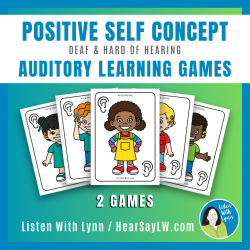
Positive Self-Concept Auditory Learning Games
$ 5
If you have kids who are deaf and hard of hearing that need a boost building their CONFIDENCE and SELF-CONCEPT then this resource is a must-have! It helps children feel good about themselves and their
...
hearing technology! The two games also target auditory memory, comprehension, descriptive vocabulary, questioning skills, grammar, and social skills.Colorful playing cards feature 16 children wearing hearing devices like hearing aids, cochlear implants, and bone-anchored hearing systems. It highlights vocabulary like unilateral, bilateral, behind-the-ear, in-the-ear, earmolds, processor, headpiece, magnet, coil, microphone, and more.
Talking and learning about hearing devices prepares kids with resilience and builds appropriate advocacy skills from an early age.
These auditory learning games are FUN for the kids and are a SIMPLE one-time prep GRAB & GO activity for you.
INCLUDES:✧ H-EARS TO YOU - Game 1
Uses differential yes or no questions to listen and isolate a "hidden" game card of a child who is deaf or hard of hearing. (Print version and a Digital version ready to screen share)✧ HEAR! HEAR! - Game 2
Players ask questions and listen to match pairs of children
with hearing loss. (Print)✧ A guide with instructions and potential listening and language outcomes. ✧ Listening and spoken language (LSL) Tips◈ ◈ ◈ ◈ ◈ ◈ ◈ ◈ ◈ ◈ ◈ ◈ ◈ ◈ ◈ ◈ ◈ ◈ ◈ ◈ ◈ ◈ ◈ ◈ ◈ ◈ ◈ ◈ ◈ ◈
CUSTOMER TIPS ➼ Questions? EMAIL ME before purchasing this resource or anytime later ➼ Earn TPT Credit towards your future purchases by leaving a review for this resource.
➼ Follow me to be updated with newbies and freebies! ♥ Sign-up HERE for the Listen With Lynn Emails
♥ Let’s Connect on Instagram and Facebook
Keep up your good work. I am blessed to help along the way.
Thanks so much!
Lynn Wood

CAVE Checklist - Communication Access in Virtual Education (French)
$ 0
The CAVE Checklist in French is a self-report checklist is intended to be completed students age 9 and above who are deaf or hard of hearing to identify possible communication access issues that may o
...
ccur during virtual education situations. It is recommended that the CAVE be completed in an interview format with the DHH specialist discussing each situation with the student. Students read 10 questions related to accessing communication in online learning situations and rate them from Always Easy to Always Difficult, or Doesn't Happen. A total score can be obtained. Not every situation will apply to every student. Situations indicating appropriate access will receive scores of 4 or 5. Items scoring 1, 2, 3, need to be addressed for appropriate access needs. The 10 questions are followed by a list in which the student identifies what he or she thinks helps most during online learning.

CAVE Checklist - Communication Access in Virtual Education (Spanish)
$ 0
The CAVE Checklist in Spanish is a self-report checklist is intended to be completed students age 9 and above who are deaf or hard of hearing to identify possible communication access issues that may
...
occur during virtual education situations. It is recommended that the CAVE be completed in an interview format with the DHH specialist discussing each situation with the student. Students read 10 questions related to accessing communication in online learning situations and rate them from Always Easy to Always Difficult, or Doesn't Happen. A total score can be obtained. Not every situation will apply to every student. Situations indicating appropriate access will receive scores of 4 or 5. Items scoring 1, 2, 3, need to be addressed for appropriate access needs. The 10 questions are followed by a list in which the student identifies what he or she thinks helps most during online learning.
Auditory Language & Learning Guide (ALLG)
$ 10
The Auditory Language & Learning Guide is an EXCELLENT informal evaluation tool for listening and language that can be used with students of any age and language ability. The 2 page checklist format e
...
asily allows the teacher to develop IEP goals based on identified student weaknesses in the 4 areas of audition/listening, receptive language, expressive language, and social communication. Skills can be rated as 'targeted', 'emerging', 'mastered' or 'previously assessed' and checked off by date achieved. This assessment tool can be used from year to year allowing instructors and parents to see growth in a students language and learning.
Hearing Aid Use Social Story
$ 175
This BoardmakerTM social story provides a clear example of how to address using hearing aids everyday and what to do if the hearing aid is not working.

 Cookies