 Your browser is out of date. For best experience switch to latest updated Browser.
 Get Chrome
 Get Edge
 Get Firefox
Ability Levels
Categories
Resource Types
Age/Grade Range
CCSS
Anchor Standard
Speaking & Listening
Language
Reading
Fluctuating - Relationship of Hearing Loss to Listening and Learning
$ 0
Handout with information on possible impact on understanding language, speECH-, social, and need for educational accommodations and services. For 16-25dB or minimal hearing loss.
Accommodations in the Classroom for the Student with "Mild" Hearing Loss
$ 0
This one-page handout for DHH professionals describes information to be shared with classroom teachers who have students with mild hearing loss (26-40 dB).
Working With DHH Students-Teacher Inservice Template
$ 3
It's the beginning of the year and time again to talk to those mainstream teachers and staff members about the students with hearing loss. Wouldn't it be nice to have a cool powerpoint or slides prese
...
entation with visuals and links? Well, here you are!! This is a template you can use "as is", or customize to your specific program. It has links to hearing loss simulations, comments on captioning and ideas from the Deaf community all ready for you to share!
ANSD - Auditory Neuropathy/Dyssynchrony Sepctrum Disorder - In Brief
$ 0
Brief informational handout about ANSD. Provides a definition, analogy to improve understanding of the impact of ANSD, diagnosis, risk factors, and intervention.
Teaching to Our Students Strengths and Needs
$ 195
This article summarizes recent research regarding the language and cognitive differences between students who are DHH and their hearing peers. Identification of these differences can help professional
...
s better understand classroom challenges faced by our students and strategies to support students through these challenges.

The Friendly Audiogram
$ 7
Interactive Learning Tool for StudentsSelf-advocacy goalTransition goalsStudent ownership Time Savers for TODsInservice Visuals, Video Links, HandoutsFillable Rubric & AudiogramMatching Rubrics & Sugg
...
ested IEP goals"The Friendly Audiogram" is an interactive set of activities for students and resources for the TOD. School-age students with hearing differences can use these activities to meet IEP goals in self-advocacy. The kid-friendly accommodations and audiogram pages are easy and engaging for younger students to understand and for older students to present at their IEP meetings. There are additional audiology-related vocabulary activities that will benefit them beyond their audiogram. For the Teachers of the Deaf, there are suggested video links for simulating hearing loss & explaining how to use common FM/DM/Sound Field, suggested IEP goals, and rubrics. The audiogram and accommodations page can be printed or emailed to families and/or staff.***For EIECSE families, this starts the family's understanding of what's to come in preschool/kindergarten. They better understand where they are headed and why applying the accommodations in the home environment is important.
In-Service Flipbook for Google Slides
$ 350
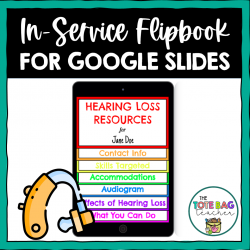
If you're an itinerant teacher of the deaf/hard of hearing you know how important it is to in-service your students' regular education teachers. Equally important, is a way for teachers to keep that i
...
nformation handy in order to reference it throughout the year. That's why I made this digital flipbook for Google Slides! This product will save you loads of time by being able to easily share your student's information.This one-page PDF includes a link to access this product via Google Slides. This editable and customizable Google Slides presentation is a handy resource to give regular education teachers so they can keep their student’s hearing loss information at their fingertips.With this convenient and easy-to-format product, you can easily share:Your contact information (and/or another staff's contact information)The skills you and your student are working onClassroom accommodationsThe student's hearing loss information and audiogramHow the student's hearing loss impacts them in the classroomRecommendations for the regular education teacher for working with d/hh studentsIf you like this easy-to-use product, please consider rating it. I truly appreciate the feedback from my fellow teachers. You will even earn credits for FREE Teachers Pay Teachers products! Talk about a win, win!
Hearing Loss and Access to Recorded Speech
$ 195
An increasing number of educational resources are being delivered through recorded speech in the younger grades, listening centers, and test examinations. This article focuses on the reasons why recor
...
ded speech are so challenging for students who are hard of hearing thus necessitating a live voice reader in many situations.
Children with Hearing Loss Miss More than You Think!
$ 0
Handout to use when raising awareness of impact of hearing loss on speech perception and comprehension. User covers with paper and reveals one section at a time to reveal visual analogies of listening
...
with hearing loss. Yellow story with translation is also available on Teacher Tools.
Role Comparisons: Supporting Students Who are Deaf or Hard of Hearing
$ 0
Handout designed to support discussion by school teams regarding the role of the teacher of the deaf/hard of hearing, educational audiologist, speECH- language pathologist, special educator, and sign
...
language interpreter in providing support and services to students with hearing loss. Includes possible issues that need to be considered specific to hearing loss.

 Cookies