 Your browser is out of date. For best experience switch to latest updated Browser.
 Get Chrome
 Get Edge
 Get Firefox
Ability Levels
Categories
Resource Types
Age/Grade Range
CCSS
Anchor Standard
Speaking & Listening
Language
Reading
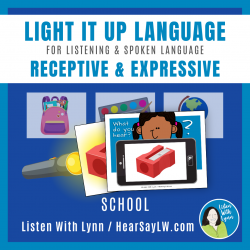
SCHOOL Auditory Processing Receptive Expressive Vocabulary Riddles
$ 5
You'll love the SCHOOL version of Light It Up Language! Kids listen to clues presented through hearing alone to identify 16 hidden SCHOOL vocabulary pictures. Each of the pictures has four clues that
...
are increasingly more specific.
The magic happens by lighting up the “What Do You Hear?” cards. Hidden pictures are held up to a flashlight and the SCHOOL images amazingly appear. How fun! Once the hidden picture is revealed the child recalls and uses the clues to describe the SCHOOL SUPPLIES. Thereby stretching their auditory memory, descriptive language, and expressive language skills. TARGETS: RECEPTIVE: This game builds critical thinking and reasoning skills by categorizing, making inferences, and drawing conclusions. EXPRESSIVE: The child recalls and uses clues to describe the hidden object. Thereby, stretching their auditory memory, descriptive language, and expressive language skills. INCLUDES:
✧ Listening & language guide with instructions
✧ Target or goal suggestions
✧ 8 What Do You Hear? cards (printed twice)
✧ 16 Hidden SCHOOL Picture Vocabulary Cards
✧ 64 Prompt Clues - 16 objects with four details each that get increasingly more specific
✧ A Script with scaffolding strategies
✧ Listening and Spoken Language Tips
➼ EASY one-time quick game prep and you're all set to use year after year.
➼ You’ll need a FLASHLIGHT, a lamp, or a sunny window.
◈ ◈ ◈ ◈ ◈ ◈ ◈ ◈ ◈ ◈ ◈ ◈ ◈ ◈ ◈ ◈ ◈ ◈ ◈ ◈ ◈ ◈ ◈ ◈ ◈ ◈ ◈ ◈ ◈ ◈ CUSTOMER TIPS: ➼ Questions? Please email me before purchasing this resource or anytime later. STAY CONNECTED: ✧ Sign-up here for the Listen With Lynn emails
✧ Follow on Facebook - Lynn A. Wood - LSL Auditory Verbal Therapist and Rehab Audiologist
✧ Follow on Instagram @auditoryverbal_listenwithlynn
❤ Keep up your excellent work. I am blessed to help along the way. Thanks so much!
Lynn Wood
Become a Listening Detective
$ 295
Listening
comprehension has an influence on reading comprehension across development.
This article focuses on auditory comprehension, making inferences when one
reads and when one hears,
...
and becoming a 'listening detective' to make
inferences from what is heard. Two activities, each with 4 parts of listen
and respond activities, mostly on fillable worksheets.
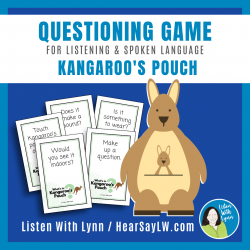
Questioning & Inferencing Game What's In Kangaroo's Pouch?
$ 5
Get the kids LISTENING and ENGAGED in this QUESTIONING and INFERENCING LANGUAGE GAME. Players LOVE to take turns secretly hiding and guessing the toys and common objects in the kangaroo's pouch. The g
...
he game is designed to play over and over again all year round.The player(s) use the 96 game cards to prompt questions and gather clues.- There are Yes/No Question cards- Action-Direction cards- Make Up Your Own Question cardsIDEAL FOR: Listening & Spoken Language, Deaf & Hard of Hearing, Speech Therapy, School Lessons, Auditory Verbal Sessions, ELAYOU CAN TARGET:Listening, critical thinking and reasoning skills while asking questions, making inferences, and drawing conclusions. Auxiliary verbs are difficult to perceive for some children that are deaf and hard of hearing.Hearing Loss and Yes/No QuestionsTo ask Yes/No questions, we use auxiliary verbs or modal verbs.These verbs tend to be spoken quickly, unstressed, and embedded in connected speech making them difficult to perceive for some children that are deaf and hard of hearing. Examples: do-does, is-are, can-could, and has-have.Designed for 2 or more players. Easy adaptable for the number of players and difficulty by sorting out cards to meet the child’s needs and goals.EASY ONE-TIME GAME PREP - Year-Round Game◈ ◈ ◈ ◈ ◈ ◈ ◈ ◈ ◈ ◈ ◈ ◈ ◈ ◈ ◈ ◈ ◈ ◈ ◈ ◈ ◈ ◈ ◈ ◈ ◈ ◈ ◈ ◈ ◈ ◈ ◈ ◈ ◈ ◈CUSTOMER TIPS:➯ Questions? Feel free to email me before purchasing this resource or anytime later.➯ Sign-up HERE for the Listen With Lynn NewsletterLet’s Connect:InstagramFacebookHearSayLW.comHearSayLW BlogKeep up your good work. I am blessed to help along the way. Thanks so much!Lynn
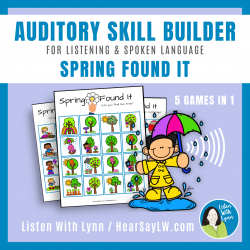
SPRING FOUND IT! Auditory Skill Builder
$ 6
SPRING Found It is a fun LISTENING & LANGUAGE AUDITORY SKILL BUILDER. Mix and Match the 5 auditory skill builder games with any of the 5 spring-themed game card sets. Players listen, auditory process
...
s information then find engaging seasonal images.FIVE LISTENING AND LANGUAGE GAMESAuditory Identification (Listening Lotto)Auditory Memory (Listen and Remember)Auditory Association (What goes together? What doesn’t belong?)Descriptions - Critical Elements (Listen and Describe)Categories - Critical Thinking (Can you find it?)FIVE DIFFERENT GAME CARDSSpring BirdsTreesGardenersColored EggsSpring Action Verbs or Activities✧ Mix and match the 5 Auditory Skill Builder Games with any of the 5 spring-themed game card sets.✧ Each game card has 16 seasonal pictures.✧The cards can also be used to teach other spring vocabulary lessons and can be played as Lotto games.Found It can be played cooperatively, for a predetermined period of time, or by filling the cards like Lotto. The games and rules are flexible and open-ended.✧ Easy to level up or down based on the child✧ Flexible! Use your own auditory targets with the game card sets✧ I’ve provided examples for you in the guide! ❤GAME ONE: Auditory Identification (Listening Lotto)Auditory identification is the ability to use the auditory channel to understand the meaning of spoken language.The Object: is for the child to listen, select and mark the correct picture named from on the board.GAME TWO: Auditory Memory (Listen and Remember)Auditory memory is the ability to recall auditory information both immediately and after a delay which is an extremely important aspect of spoken language development. Auditory memory growth enables children to speak in longer and more complex grammatical sentences. The Object: is for the child to listen and recall two, three, and four-word sets.Game THREE: Auditory Association (What goes together? What doesn’t belong?)Auditory Association is the process of attaching meaning to something heard by relating it to previously learned information.The Object: What Goes Together?Have the child listen, repeat the words and explain how they go together or are associated. Next, find and mark the correct pictures on the board.The Object: What Doesn’t Belong?Have the child listen, repeat the words using their auditory memory then tell what doesn’t belong and why. Next, find and mark the correct pictures on the board.Game FOUR: Descriptions - Critical Elements (Listen and Describe)Descriptive language adds information that makes the language more colorful and appealing.The Object: is for the child to listen and identify a picture based on descriptions and critical elements.This activity builds vocabulary and descriptive language skills.Game FIVE: Categories - Critical Thinking (Can you find it?)Categories are a group or class of items with shared characteristics. The ability to use categories builds vocabulary and logical thinking skills. It includes auditory reception, memory, and comprehension.The Object: is for the child to listen to the category then identify the picture(s).Easy Game Prep Print Version: Print the game cards and laminate them. Gather game markers like winter-themed winter erasers or Bingo Chips.Digital Version: Play with your favorite PDF reader app or on a tablet or iPad. When playing on a computer, open and use a PDF reader such as the free Adobe Acrobat Reader DC. Use the annotation tools to mark the game cards.Resource Includes:- Individual directions for each of the 5 games- 6 game cards with 4 variations of each (24 cards in total)- Listening & language guide- Target or goal suggestions- Directions to level up or level down- Listening and spoken language tips- Print and digital options◈ ◈ ◈ ◈ ◈ ◈ ◈ ◈ ◈ ◈ ◈ ◈ ◈ ◈ ◈ ◈ ◈ ◈ ◈ ◈ ◈ ◈ ◈ ◈ ◈ ◈ ◈ ◈ ◈ ◈ ◈ ◈ ◈ ◈CUSTOMER TIPS:➯ Questions? Feel free to email me before purchasing this resource or anytime later.➼ Sign-up HERE for the Listen With Lynn NewsletterLet’s Connect:InstagramFacebookPinterestHearSayLW.comHearSayLW BlogTwitterKeep up your good work. I am blessed to help along the way. Thanks so much!Lynn
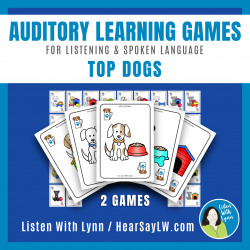
TOP DOGS Two Listening and Language Auditory Learning Games
$ 7
If you looking for TWO listening and language games to play all year long you’ve come to the right place! These fun dog-loving games are an easy, stress-free way to practice listening skills, and buil
...
s, and build spoken language, descriptive vocabulary, questioning skills, and auditory processing skills.YOU CAN TARGET: These games target and can build auditory memory, comprehension, processing, descriptive vocabulary, grammar, using clear speech, and social skills.TWO GAMES IN ONE RESOURCE: Game 1: TOP DOG* is a two-player game where players use differential yes or no questions to listen and isolate a specific dog based on critical elements. Game 2: GO FETCH* is a two or more-player game where players ask questions and listen to match pairs of dogs and their belongings cards. Kids love these cute and cuddly dogs and ask to play time and time again. I have used versions of both of these games SUCCESSFULLY for years while working with children who are deaf and hard of hearing, those with auditory processing needs, and students who need to develop listening skills.* These games are versions of the traditional Go Fish and Guess Who games that are played with rules to target listening and spoken language skills. Both games can easily be adapted to meet a child’s ability level. The cards can be sorted into sets of fewer cards which would be an easier listening set. Use all 36 different card designs for a more complex game.INCLUDES:✧ A complete guide with detailed instructions ✧ 36 enticing colorful game cards used for both TOP DOG and GO FETCH!✧ A digital gameboard for Top Dog✧ Listening and Spoken Language TipsFACE TO FACE - TELETHERAPY - HOME✢ PRINT - One-time easy prep. ✢ DIGITAL - The Top Dog digital gameboard can be opened and played with your favorite PDF reader app on a tablet or iPad. Tokens can be placed directly on the screen.on a computer. Open the PDF game board with the 36 spring egg images and use a PDF reader such as Adobe Acrobat Reader DC which is free. The listener used the annotation tools to mark the cards like Lotto.YOU ASKED. I LISTENED. I created a second dog-themed resource based on many of your requests and the rave reviews that kids are so motivated by my LOST DOG and MY PET CAT animal activities. You will want all three resources in your Listening and Language Toolbox.PLEASE NOTE: This activity and the LOST DOG resource contain many of the same images that are bright, enticing, and vocabulary rich. However, these two resources target completely different auditory and language-based goals.◈ ◈ ◈ ◈ ◈ ◈ ◈ ◈ ◈ ◈ ◈ ◈ ◈ ◈ ◈ ◈ ◈ ◈ ◈ ◈ ◈ ◈ ◈ ◈ ◈ ◈ ◈ ◈ ◈ ◈ CUSTOMER TIPS:➼ Questions? Email me before purchasing this resource or anytime later.➼ Sign-up HERE for the Listen With Lynn Emails♥ Let’s Connect:InstagramFacebookKeep up your good work. I am blessed to help along the way.Thanks so much!Lynn Wood
Promote Auditory Decoding - Reading Words with -s, -es, ed Endings
$ 195
When using phonics skills, a student is accessing a learned association between a printed letter or letters and the associated sounds. For example, the letter d is associated with the first sound in d
...
og. Consider that letter d, however, in the word walked, when it is produced with the /t/ sound in the past tense -ed ending. Use this fun game with students to practice discriminating, saying, and reading the -s and -es endings.
Article: Grammar Structures and Deaf and Hard of Hearing Students: A Review of Past Performance And a Report of New Findings
$ 0
Results of a study are presented that suggest that grammatical structures of English some deaf and hard of hearing students struggle to acquire. Results indicated the specific grammatic structures typ
...
ically of challenge.
Conjunctions - CGC
$ 195
Articles & Conjunctions Packet - Conjunctions. This Cracking the Grammar Code instructional packet contains 6 activities with the following goals: The student will list seven coordinating conjunctions
...
. The student will write sentences accurately using conjunctions. The student will write paragraphs with and without using conjunctions. Includes pretest. Fillable worksheet format.
Weaving Auditory Skills into Common Core: Lessons Targeting Final /s/ and 'it; vs. 'they'
$ 195
Materials and instructions for simultaneous practice of auditory and language objectives: 1) two language levels to practice auditory objective-/s/ or no /s/ in final position of words in spoken sent
...
ences; and language objective - choosing it or they for inanimate 1st person subject. 2) identify pronoun in spoken sentences; indicate if pronoun agrees in number with the antecedent. Includes forms for data collection.
Listening for Final /s/ or /z/
$ 195
Information for teacher about components of auditory perception. Materials and instructions to practice: 1)auditory identification of final /s/ and /z/ in regular plural nouns, 2) suprasegmental aware
...
ness final /s/ or /iz/ (one- vs two-syllable words) and 3)final /s/ or /z/ in words within sentences for subject-verb agreement. Includes 40 pictures of single/plural objects and 10 sentence prompts. Suggestions for differentiation.

 Cookies