 Your browser is out of date. For best experience switch to latest updated Browser.
 Get Chrome
 Get Edge
 Get Firefox
Ability Levels
Categories
Resource Types
Age/Grade Range
CCSS
Anchor Standard
Speaking & Listening
Language
Reading
Math specific language - Imagery in Math
$ 195
Visual-spatial processing is the ability to tell where objects are in space. It is the ability to form mental representations of how objects appear and to move these representations in the mind. This
...
type of mental imagery is essential for math. These instructional strategies and activities include drawing representations of problems to find the answer, visualizing angles and shapes, and critical thinking skills.
How Artithmetic Word Problems Help with Language Development
$ 0
Arithmetic word problems offer a large array of language development opportunities, particularly for children with hearing loss. Learn how you can use arithmetic word problems to help your child disco
...
ver the nuances of conversation. Introduction to mathematic-specific process information.
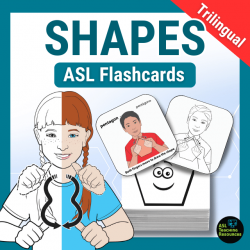
2D Shapes Flashcards
$ 399
Welcome to the exciting world of Printable Shapes Flashcards, where learning shapes is a breeze while delving into the art of Sign Language. These trilingual flashcards feature 12 common 2D shapes and
...
icons and offer an excellent opportunity to enhance your shape recognition skills, which, in turn, can significantly boost your vocabulary and math skills.These flashcards aren’t just educational tools; they’re designed to make learning enjoyable. Each card showcases a beautifully illustrated shape and corresponding sign in American Sign Language (ASL) and Spanish. This unique combination enhances your shape recognition and adds a new dimension to your learners’ language abilities.2D Shapes FlashcardsUnderstanding shapes is not just about geometry; it’s also about expanding your vocabulary and improving your math skills. Shapes are the building blocks of our visual world, and by visualizing and recognizing them, you can strengthen student’s cognitive skills. This cognitive exercise goes a long way toward improving understanding of concepts and solving problems, making it beneficial for learners of all ages.What sets the trilingual Printable Shapes Flashcards apart is their flexibility. You can choose your difficulty level, making them suitable for beginners and advanced learners. If you’re starting, opt for the icons or sign flashcards with English/Spanish hints for extra guidance. If you feel confident, select the version without hints to challenge and enhance learners’ problem-solving abilities.Everyone has a different learning style, so these flashcards are available in colored and black-and-white versions. Whether you prefer the vibrancy of colors or the simplicity of black and white, these shape flashcards cater to your learners’ preferences.Learning shapes doesn’t have to be dull and one-dimensional. With Printable Shapes Flashcards, you’ll improve student’s shape recognition, enrich their vocabulary, and sharpen their math skills. This makes them an ideal educational tool for parents, teachers, and learners of all levels, offering a dynamic and comprehensive learning experience.Shapes Flashcards Benefits• Vocabulary enhancement• Accommodate different learning styles• Inclusive learning levels• Boost memory retention• Connect vocabulary to real-world concepts• Improve fine motor skills• Learn Sign Language• Learn Spanish
Division: Using Math to Help with Language
$ 0
Arithmetic word problems offer a large array of language development opportunities, particularly for children with hearing loss. Learn how you can use division word problems to help your child discove
...
r the nuances of conversation.
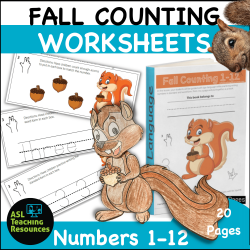
Sign Language Counting 1-12 Squirrel
$ 595
Embark on a learning adventure with Mr. Squirrel as your guide with the Sign Language Counting 1-12 Squirrel worksheet! This downloadable product offers a fun and interactive way for students to maste
...
r writing, counting, and signing numbers. With 20 pages of engaging activities, children can practice counting from 1 to 12 while reinforcing sign language skills. Divided into three sections, students will have the opportunity to cut and count acorns to match the number, practice writing numbers in both standard and word form, and enjoy additional squirrel-themed extras like coloring Mr. Squirrel and crafting their own squirell and acorn masterpiece. Simply download the file, print it on your printer, and assemble it into a convenient book format for endless educational fun!
Addition: Using Math to Help with Language
$ 0
Arithmetic word problems offer a large array of language development opportunities, particularly for children with hearing loss. Learn how you can use addition word problems to help your child discove
...
r the nuances of conversation.
Preparing for school: Literacy and Numeracy
$ 6
Age-appropriate listening and language skills are required for any child to succeed at school. At school, more advanced developmental skills, namely literacy and numeracy skills, are developed. A pare
...
nt can already start to introduce basic literacy and numeracy concepts to a child as of birth. Parents do not always realize that preparing the child beforehand to learn each of these skills, is vital. Before children go to school, they need to acquire certain skills that will help them to read and write. This is the joint responsibility of the parents and the child’s educational team, such as the teacher of the deaf/hard of hearing, early intervention provider, speech-language therapist, and/or preschool teacher.Emergent literacy: Before teaching reading and writing skills, a child needs to know the processes and concepts involved in reading and writing. Emergent literacy skills discussed in this lesson include literacy socialization, phonological awareness, as well as printed word and alphabet knowledge. Reading is the process through which meaning is attached to written symbols and letters. It is about comprehending and actively responding to the content.Writing is the use of symbols to communicate thoughts and ideas. It is a way to represent language in a visual and tactile form. The development of the different components of emergent literacy, reading and writing is discussed in this lesson.
Literacy instruction - Measuring time
$ 195
Time
is a very abstract concept, and teaching time requires both direct instruction and real world application. Instructional strategies and activities are included for telling time, using tim
...
melines, sequencing,
predicting and measuring how much time an activity takes/will take; and
matching significant holidays with months of the year.
Holidays & Seasonal - National Pi Day
$ 0
These worksheets and activities are a fun way to introduce new vocabulary, start a discussion, and extend a language or math lesson about Pi. Includes language activities and fillable worksheets for
...
understanding and using jokes and riddles associated with the symbol and word Pi.
Literacy Instruction Math language comprehension
$ 195
Language skills, vocabulary knowledge, and thought processes are required to solve math word problems. Effective mathematic problem solvers are like effective readers. Instructional strategies and a
...
ctivities include locating key information, distinguishing between main idea and supporting details, and constructing meaning from text. Includes how to use the KNOWS strategy to understand what information is necessary to solve word problems.

 Cookies