 Your browser is out of date. For best experience switch to latest updated Browser.
 Get Chrome
 Get Edge
 Get Firefox
Ability Levels
Categories
Resource Types
Age/Grade Range
CCSS
Anchor Standard
Speaking & Listening
Language
Reading
Conversational Skill Development
$ 195
This packet provides information on how to develop a child's conversational competence. It describes the elements of the 4 stages of conversational skills. This description is followed by forms used f
...
or tracking the development of conversational competence at each of these 4 stages. Examples are provided throughout to familiarize the family or educator who is less familiar with Brown's Stages of language development. Finally, this packet includes intervention strategies for improving conversational competence, including providing clarification, role-switching, requesting clarification and prompting. Examples of each of these strategies is provided. There are scenarios then provided to allow teachers/families with ideas for how they can shape the conversational competence of the child.

SIFTER - Secondary Screening Identification for Targeting Educational Risk - User's Manual
$ 0
The Screening Instrument For Targeting Educational Risk (SIFTER) was created as a tool to screen the functional performance of students with hearing loss in preschool in preschool, elementary and seco
...
ndary school and includes a scoring grid to identify areas of concern. This User Manual focuses on secondary students and will explain the background, development, validity, effectiveness and reliability of the SIFTER.
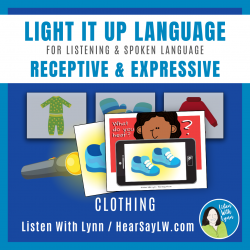
CLOTHING Auditory Processing Receptive & Expressive Language
$ 5
You'll love the CLOTHING version of Light It Up Language! Kids listen to clues presented through hearing alone to identify 16 hidden CLOTHING vocabulary pictures. Each of the pictures has four clues t
...
ues that are increasingly more specific.The magic happens by lighting up the “What Do You Hear?” cards. Hidden pictures are held up to a flashlight and the CLOTHING images amazingly appear. How fun! Once the hidden picture is revealed the child recalls and uses the clues to describe the CLOTHING. Thereby stretching their auditory memory, descriptive language, and expressive language skills.TARGETS: RECEPTIVE: This game builds critical thinking and reasoning skills by categorizing, making inferences, and drawing conclusions. EXPRESSIVE: The child recalls and uses clues to describe the hidden object. INCLUDES:✧ Listening & language guide with instructions✧ Target or goal suggestions✧ 8 What Do You Hear? cards (printed twice)✧ 16 Hidden CLOTHING Picture Vocabulary Cards✧ 64 Prompt Clues - 16 objects with four details each that get increasingly more specific✧ A Script with scaffolding strategies✧ Listening and Spoken Language Tips ➼ EASY one-time quick game prep and you're all set to use year after year. ➼ You’ll need a FLASHLIGHT, a lamp, or a sunny window.◈ ◈ ◈ ◈ ◈ ◈ ◈ ◈ ◈ ◈ ◈ ◈ ◈ ◈ ◈ ◈ ◈ ◈ ◈ ◈ ◈ CUSTOMER TIPS:➼ Questions? Please email me before purchasing this resource or anytime later.♥ Sign-up HERE for the Listen With Lynn emails♥ For more ideas visit my blog: HearSayLW.comSTAY CONNECTED:✧ Sign-up here for the Listen With Lynn emails✧ Follow on Facebook - Lynn A. Wood - LSL Auditory Verbal Therapist and Rehab Audiologist✧ Follow on Instagram @auditoryverbal_listenwithlynn❤ Keep up your excellent work. I am blessed to help along the way. Thanks so much!Lynn Wood

Self-Advocacy: End of the Year Paired Reflections for Student and DHH Teacher
$ 2
This no-prep activity is ideal to use at the end of the school year with your deaf or hard-of-hearing students. Use this resource as an opportunity to reflect on the school year, your student's growth
...
and needs, and your own growth and needs as a teacher as well. Having an open dialogue with your student using these guiding questions will help you to understand how you can further support them as a Teacher of the Deaf and Hard-of-Hearing.This resource contains a reflection pages students to complete, a reflection page for teachers to complete, and a supports page for both to complete together.
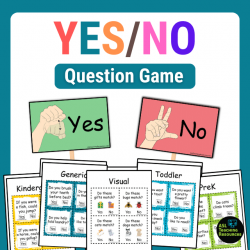
Yes or No Question Game
$ 325
This Yes or No Question Game is designed to be used during your morning meetings, signing time, circle time, etc. Pick one question a day for students to answer. Allow more time for group discussion o
...
f students’ answers.The next time your kids walk into the room, ask them a question. For more engagement, use these Yes or No question game cards as conversation starters. You’ll find some of these questions are funny, some are factual, and some are thought-provoking as you engage with your students in a “get-to-know-you” time.Pick one question a day for students to answer to allow more time for group discussion of students’ answers/preferences.
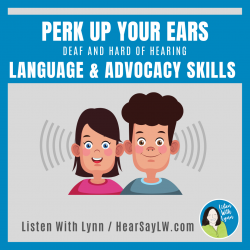
Figurative Language & Self Advocacy PERK UP YOUR EARS
$ 7
A must-have GRAB-N-GO language-rich resource that builds figurative language skills while encouraging self-advocacy. PERK UP YOUR EARS contains 20 passages with ear-related sayings or idioms with stun
...
stunning photographs kids love. It builds figurative language, nuances in word meanings, and vocabulary that are essential to spoken and written language, pragmatics, and communication competence.INCLUDES:- 20 Passages with Ear-Related Sayings and Idioms- Listen-Talk-Reflection Discussion prompts- Guide with instructions- Listening and Spoken Language TipsA no-prep or planning because everything is in this resource.This Digital - No Print resource can be opened and played with your favorite PDF reader app on a tablet. When playing on a computer, open and use a PDF reader such as the free Adobe Acrobat Reader DC.Ideal for: Speech Language Therapy, Listening and Spoken Language, Teachers of the Deaf and Hard of Hearing, Auditory Verbal Sessions. It can be easily used by parents at home, teachers, and therapists both face-to-face and in teletherapy.Boom LearningPerk Up Your Ears is also available as a Boom Deck in the Listen With Lynn Boom Learning store. ◈ ◈ ◈ ◈ ◈ ◈ ◈ ◈ ◈ ◈ ◈ ◈ ◈ ◈ ◈ ◈ ◈ ◈ ◈ ◈ ◈ ◈ ◈ ◈ ◈ ◈ ◈ ◈ ◈ ◈ ◈ ◈CUSTOMER TIPS:➼ Feel free to email me with questions, before purchasing this resource or anytime later.➼ Click here to stay updated!➼ Be the first to know about freebies, sales, and product launches.➼ New products are 50% off the first 24 hoursSTAY CONNECTED:✧ Sign up here for the Listen With Lynn Email✧ Follow on Facebook✧ Follow on Instagram❤ Keep up your excellent work. I am blessed to help along the way. Thanks so much! Lynn
Learning to Listen Sounds
$ 5
When children with hearing differences are Learning to Listen, caregivers and parents can use this reference tool to guide them as they help their child learn to attach meaning to the sounds of speech
...
. Beginning with the LMH 10 Sounds and moving into the early developing CV, VC, and CVCV sounds, this chart helps spark ideas for listening games and play time.
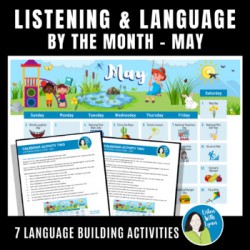
MAY LISTENING VOCABULARY COMPREHENSION
$ 5
The MAY Listening and Language By The Month resource includes seven activities that can be used for auditory memory and comprehension, seasonal vocabulary, developing grammar, and building conversatio
...
nal skills.
Work smarter, not harder by strategically including ongoing calendar activities all year long while growing listening, building language, literacy, and academic skills.
Time concepts are taught, learned, and understood with repetition and practiced over time. The calendar lessons included are based on years of working with children who are deaf and hard of hearing and guiding their families.
Seven activities or mini-lessons with four May calendars
1. Create an experience-based calendar2. Listen and follow directions3. Auditory comprehension4. Auditory Inferencing using Zoe’s Calendar5. Conversations Barrier Game
6. Auditory comprehension and integration - Fun Facts About May.7. Make your own calendar. Perpetual calendar activity.
Includes
✢ A guide for growing vocabulary and time concepts and instructions for using these activities
✢ Listening and Spoken Language Tips
✢ Engaging activity calendars with rich vocabulary and colorful images
Teletherapy, Distance Learning & Face to Face
✧ Print version
✧ Interactive PDF - No Print version can be opened and played with your favorite PDF reader app on a tablet. When playing on a computer, open and use a PDF reader such as Adobe Acrobat Reader DC which is free.
PLEASE NOTE: The activity calendar's content and graphics are designed to correspond with each month but not for a specific calendar year. The calendars do not include a year to keep the product evergreen and usable year after year. In my therapy sessions, we talk about the featured child - for May it is Zoe and her calendar and activities. STAY CONNECTED✧ Follow on Facebook - Lynn A. Wood - LSL Auditory Verbal Therapist and Rehab Audiologist✧ Follow on Instagram @auditoryverbal_listenwithlynn✧ Sign-up here for the Listen With Lynn Newsletter to be the first to know about freebies, sales, and product launches.✧ Feel free to email me with questions, before purchasing this resource or anytime later. ❤ Keep up your good work. I am blessed to help along the way. Thanks so much! Lynn
"Ideal" vs. "Difficult" Listening Scenarios Part 2
$ 375
This product contains 15 self-advocacy scenarios for geared to help deaf and hard-of-hearing students. There are both "ideal" listening situations and "difficult" listening situations included in orde
...
r to help students develop self-advocacy and problem solving skills.Read each scenario and ask your student to determine if is an "ideal" listening situation or a "difficult" listening situation. If it is a difficult situation, what can be done to fix it?This product is best used with students who are in upper elementary grades and up. It contains both school-based and community-based scenarios.
End of the Year Vocabulary Exposure Challenge
$ 5
We all know that our DHH learners need to be taught vocabulary intentionally for a number of reasons. We also know that students need to be exposed to vocabulary words several times in order for them
...
to internalize them. Vocabulary development is a crucial skill for our DHH learners. I created this resource for teachers to provide to families and/or older students during summer break.Encourage families to join this vocabulary exposure challenge over the summer! This resource contains 7 summer-themed word lists that can be given to families and students. Challenge families to take action and pick at least one word per day to use with their DHH learner in context. Have the families talk about the words with the students. Or, you can encourage your older students to pick one word a day to use and look up. Along with the lists, there is a chart that can be used to track the words that are used weekly.This could also be used as a resource for ELL learners or enrichment for students.

 Cookies